




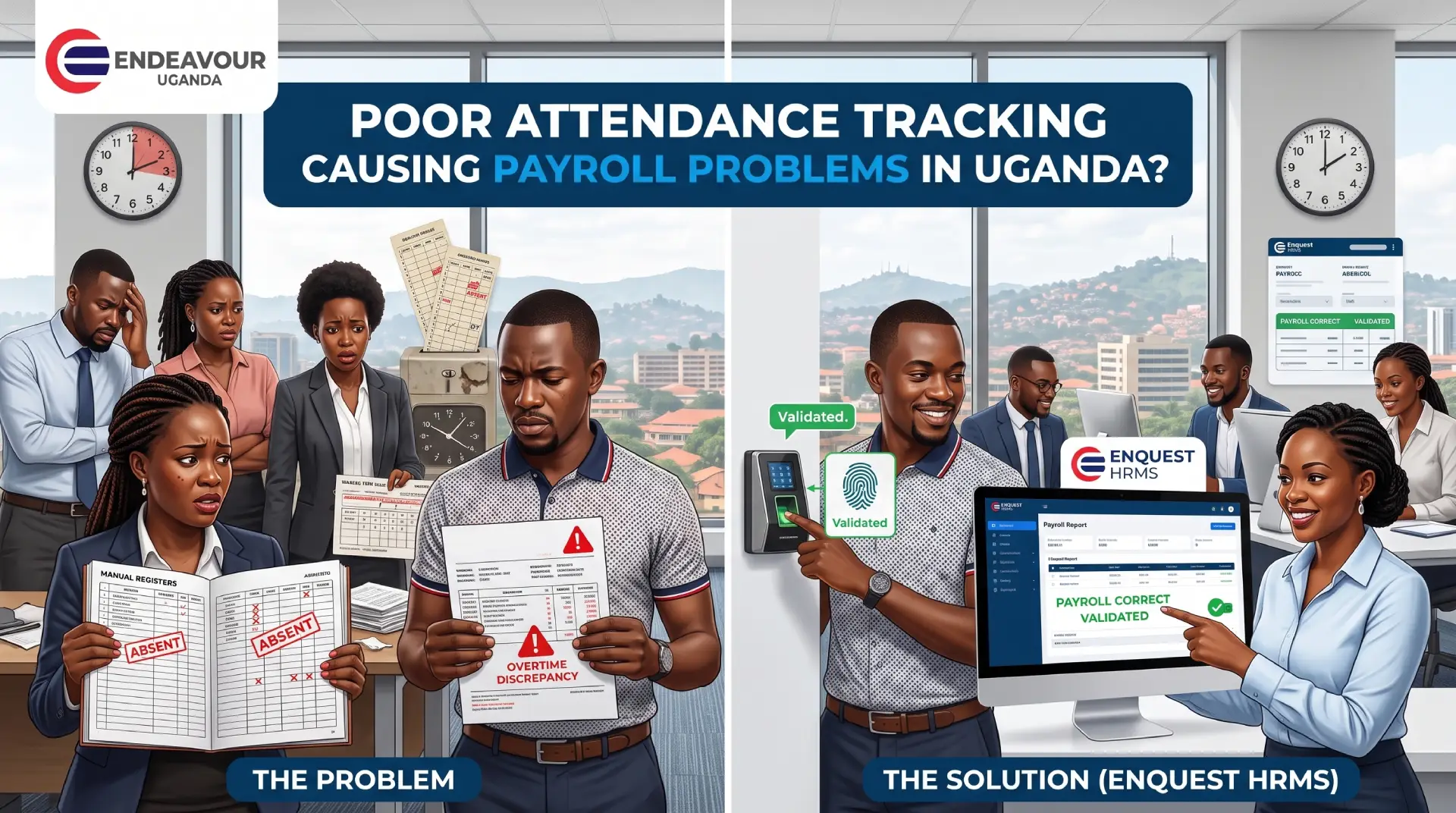
Payroll accuracy doesn’t begin when the salary is calculated.
It begins much earlier – with accurate employee information and reliable attendance records.
For many businesses, payroll teams spend considerable time checking employee attendance, working hours, leave, overtime, late arrivals and absences before payroll can be finalized.
If those attendance records are inaccurate, incomplete or managed manually, the payroll process can quickly become complicated.
An employee may work overtime that is not recorded.
Another employee may have an incorrect absence recorded.
Someone may forget to sign an attendance register.
A manager may approve overtime through a WhatsApp message but forget to submit it to HR.
By the time payroll is processed, HR may be working with incomplete information.
This is why employee attendance tracking and payroll management should not be treated as completely separate processes.
For growing businesses in Uganda, an integrated payroll and attendance approach can help create a more structured flow of employee information.
Enquest HRMS by Endeavour Uganda is designed to help businesses centralize important HR processes, while Endeavour Uganda also provides dedicated payroll, time attendance and biometric solutions.
Let’s look at the hidden payroll problems that can result from poor attendance tracking – and how businesses can address them.
Why Attendance Tracking Matters to Payroll
At first glance, attendance and payroll may seem like two different HR functions.
Attendance answers questions such as:
- Did the employee come to work?
- What time did they arrive?
- What time did they leave?
- How many hours did they work?
- Were they absent?
- Did they work overtime?
- Which shift did they work?
Payroll answers questions such as:
- How much should the employee be paid?
- What deductions apply?
- How much overtime should be included?
- What allowances apply?
- What is the employee’s final pay?
But these processes are connected.
If attendance information is wrong, payroll calculations that depend on attendance can also be affected.
The Basic Payroll Flow
For many businesses, the process looks something like this:
Employee Schedule → Attendance → Working Hours → Overtime/Absence → Payroll Calculation → Salary
If the attendance information in the middle is inaccurate, the payroll process may require additional manual checking.
This is one reason modern HR technology is increasingly moving toward connected systems rather than separate spreadsheets and disconnected tools. HR technology trends in Africa in 2026 emphasize system consolidation, payroll automation and integrated HR data.
1. Incorrect Attendance Can Lead to Incorrect Payroll
One of the most obvious problems is also one of the most common.
If an employee’s attendance record is incorrect, HR may use incorrect information when preparing payroll.
For example:
An employee works 22 days during the month, but the attendance spreadsheet shows 20 days.
Or an employee works additional hours, but those hours are missing from the attendance record.
Or an employee is incorrectly marked absent.
These differences may eventually affect payroll.
Why Manual Attendance Creates Risk
Manual attendance systems often depend on:
- Employees signing registers
- Supervisors checking attendance
- HR entering data
- Excel calculations
- Manual corrections
- Paper records
Every manual step creates another opportunity for an error.
For businesses searching for payroll software Uganda, improving the data feeding into payroll can be just as important as automating the payroll calculation itself.
2. Poor Attendance Tracking Can Cause Overtime Problems
Overtime is directly connected to working hours.
If the business does not accurately know when employees started and finished work, it may struggle to calculate additional working hours correctly.
An employee may say they worked three hours of overtime.
The attendance register may show only one hour.
Another employee may have worked overtime but forgotten to record it.
Overtime Needs Reliable Time Data
A proper overtime tracking system should work from reliable attendance and schedule information.
Businesses should ideally have a process that looks like:
Scheduled Hours → Actual Attendance → Additional Hours → Overtime Approval → Payroll
This creates a more structured process than manually collecting overtime information at the end of the month.
Endeavour Uganda’s Time Master software supports time and attendance management, including shift and overtime-related processes.
3. Attendance Errors Can Create Salary Disputes
Few things are more sensitive to employees than their salaries.
When an employee believes they have been underpaid, one of the first questions may be:
“Why is my salary different this month?”
The answer could be related to:
- Missing overtime
- Incorrect absence
- Incorrect working days
- Wrong leave information
- Incorrect attendance
- Payroll data-entry errors
If the company does not have reliable attendance records, resolving the dispute can take significant time.
A Clear Attendance Trail Helps
A digital employee attendance system can provide structured attendance information that HR teams can review.
Instead of searching through paper registers and spreadsheets, HR can work from a centralized attendance record.
This can make payroll queries easier to investigate.
4. Manual Attendance Can Affect Leave and Payroll
Attendance is not only about clock-in and clock-out times.
Leave is also part of employee time management.
Businesses may need to track:
- Annual leave
- Sick leave
- Authorized absence
- Unpaid leave
- Other approved leave
- Leave balances
If leave records are maintained separately from attendance and payroll, HR teams may have to manually reconcile the information.
Leave and Payroll Should Be Connected
A good attendance management system should work alongside broader employee management processes.
This is one of the advantages of using an integrated HRMS Uganda solution.
With Enquest HRMS by Endeavour Uganda, businesses can move toward a centralized approach to employee information and HR processes rather than relying entirely on disconnected spreadsheets.
You can explore Enquest HRMS by Endeavour Uganda for a broader employee management solution.
5. Late Arrivals and Early Departures Can Be Difficult to Track
Imagine an employee is scheduled to work from 8:00 AM to 5:00 PM.
They arrive at 9:15 AM several times during the month.
If the business is using a paper attendance register, HR may need to manually review every entry to identify the pattern.
The same applies to early departures.
Why Digital Time Tracking Helps
Employee time tracking software can organize employee attendance information and make it easier to identify patterns such as:
- Late arrivals
- Early departures
- Absences
- Missing attendance
- Working-hour differences
For businesses with larger workforces, this can save HR teams considerable administrative time.
6. Poor Shift Tracking Can Affect Payroll
Shift-based businesses face additional challenges.
A company may have:
- Day shifts
- Night shifts
- Weekend shifts
- Rotating shifts
- Extended shifts
- Different department schedules
If employee shifts are not properly recorded, HR may struggle to understand whether an employee’s working hours were normal, additional or outside their scheduled shift.
Shift Management and Payroll
A shift management system can help businesses organize employee schedules and compare them against actual attendance.
This is especially useful when payroll calculations depend on working hours, overtime or shift-related allowances.
Endeavour Uganda’s Time Master solution can support businesses that need structured time attendance software Uganda for employee attendance and shift management.
7. Manual Attendance Can Make Payroll Processing Slower
Payroll teams often work against deadlines.
They need to:
- Collect employee data.
- Check attendance.
- Review leave.
- Verify overtime.
- Calculate payroll.
- Review deductions.
- Generate reports.
- Process salary payments.
If attendance information is scattered across multiple spreadsheets or paper registers, the payroll process can become slower.
Payroll Automation Starts With Clean Data
Payroll automation is not only about pressing a button to calculate salaries.
The information going into the payroll process needs to be accurate.
This is why integrated HR and payroll software Uganda solutions can be useful.
Payroll technology trends across Africa in 2026 increasingly emphasize automation, integration with HR systems and centralized workforce data.
8. Attendance Data Can Be Duplicated or Entered Incorrectly
Suppose your business uses:
- One spreadsheet for attendance
- Another for overtime
- Another for leave
- Another for payroll
- A paper register at the office
HR may need to copy information between several sources.
This creates opportunities for:
- Duplicate records
- Missing records
- Wrong employee names
- Wrong dates
- Incorrect hours
- Outdated information
One Employee Record Is Better Than Multiple Versions
An integrated employee management software Uganda solution can help businesses work toward maintaining employee information in a centralized environment.
Instead of maintaining several disconnected versions of employee data, HR teams can work from a more consistent source of information.
9. Poor Attendance Tracking Can Hide Payroll Costs
Attendance data is not only useful for calculating salaries.
It can also reveal workforce costs.
For example, management may discover:
- High overtime in one department
- Frequent absenteeism
- Excessive late arrivals
- Understaffed shifts
- Employees consistently working beyond scheduled hours
Without structured attendance information, these patterns can be difficult to identify.
Turn Attendance Data Into Business Insights
A modern workforce time tracking solution can provide management with more useful information about how employees spend working time.
This can support better workforce planning.
Instead of asking:
“Why is payroll increasing?”
management can investigate:
“Which departments are generating the most overtime?”
or:
“Why are additional working hours increasing every month?”
That is a much more useful management question.
10. Poor Records Can Make Payroll Audits More Difficult
Businesses need reliable employee records.
Uganda’s current consolidated Employment Act includes provisions relating to employee pay statements and written employment particulars, including normal working hours and applicable overtime pay. It also addresses the production and accuracy of employment-related information in certain circumstances.
This makes record keeping important.
Keep Attendance and Payroll Information Organized
Businesses should be able to explain how payroll figures were calculated.
That means maintaining appropriate records for:
- Employee information
- Attendance
- Working hours
- Overtime
- Leave
- Salary
- Deductions
- Pay statements
A structured HRMS can help organize these records more effectively than a collection of unrelated spreadsheets.
11. Biometric Attendance Can Improve Attendance Data
For businesses looking to reduce manual attendance entry, biometric technology can provide another option.
A biometric attendance system Uganda businesses use can identify employees through technologies such as:
- Fingerprint recognition
- Facial recognition
- Other biometric verification methods
Instead of employees manually writing their arrival time, the system records the attendance event digitally.
Biometric Attendance and Payroll
The potential workflow is:
Biometric Verification → Attendance Record → Working Hours → Overtime/Absence → Payroll
This can reduce manual attendance entry and make it easier to connect attendance information with payroll processes.
Endeavour Uganda also provides a Face Recognition System in Kampala, Uganda for businesses looking to modernize employee identification and attendance management.
12. Poor Attendance Data Can Increase HR Workload
When attendance records are inaccurate, someone has to fix them.
That person is often HR.
HR may spend time:
- Calling supervisors
- Checking paper registers
- Comparing spreadsheets
- Asking employees about attendance
- Verifying overtime
- Correcting payroll data
- Answering salary questions
This means HR spends less time on higher-value activities such as employee development, performance management and workforce planning.
HR Automation Can Reduce Repetitive Work
A centralized HR software Uganda solution can help automate and organize repetitive HR processes.
For businesses looking to modernize employee management, Enquest HRMS by Endeavour Uganda provides a broader HR management environment.
How Poor Attendance Tracking Affects Employees
The consequences are not only financial or administrative.
Poor attendance records can affect employee trust.
Imagine an employee who worked several hours of overtime but does not see those hours reflected in payroll.
Or an employee who was approved for leave but is incorrectly recorded as absent.
Even when the mistake is accidental, repeated payroll issues can create frustration.
Accurate Records Support Employee Confidence
A structured payroll and attendance system can help create a more consistent process.
Employees should be able to understand how their working time and payroll information are being handled.
Clear records can also help HR investigate questions when they arise.
The Relationship Between Attendance, Overtime and Payroll
Think of these three HR functions as connected:
Attendance
Records when employees actually work.
↓
Overtime
Identifies additional working hours based on schedules, policies and applicable rules.
↓
Payroll
Uses approved payroll information to calculate employee compensation.
When these processes operate separately, HR teams may have to move information manually between systems.
When they are integrated, the flow can become more structured.
What Should a Modern Attendance Management System Include?
If you’re evaluating an attendance management system, don’t look only at clock-in and clock-out.
Consider the full HR workflow.
Employee Attendance
The system should capture employee attendance consistently.
Time Tracking
It should help HR understand actual working hours.
Shift Management
It should support different employee schedules.
Overtime Tracking
It should help identify and manage additional working hours.
Leave Management
Leave information should be organized alongside employee records.
Payroll Integration
Attendance and overtime information should be usable in payroll processes where supported.
Reporting
HR and management should be able to access useful attendance reports.
Employee Records
Attendance should be associated with the correct employee profile.
Access Controls
Employee information should be protected through appropriate access controls.
How Enquest HRMS Can Help Businesses in Uganda
Enquest HRMS by Endeavour Uganda is designed to help businesses move toward more centralized employee and HR management.
Instead of maintaining separate spreadsheets for every HR activity, businesses can work toward an integrated environment covering areas such as:
- Employee management
- Attendance
- Payroll
- Leave
- Time tracking
- Overtime
- HR reporting
- Workforce administration
For businesses searching for HR solutions Uganda, this integrated approach can help reduce fragmented HR processes.
It also supports the broader shift toward connected HR systems seen across African businesses in 2026.
What About Dedicated Payroll Software?
Some businesses may already have an HR system but still require a dedicated payroll solution.
In that case, it is important to understand how attendance information will move into payroll.
Businesses should ask:
- Can attendance data be exported?
- Can overtime information be transferred?
- Can employee records be synchronized?
- Can payroll administrators review attendance-related adjustments?
- Can payroll reports be reconciled with attendance reports?
For organizations looking for a dedicated payroll solution, Pay Master Payroll Software from Endeavour Uganda can be considered.
The key is not simply choosing payroll software.
It is creating a reliable attendance → payroll workflow.
7 Warning Signs Your Attendance Tracking Needs Improvement
Your business may need to review its current attendance process if:
1. Payroll Staff Manually Recalculate Attendance
Your payroll team spends hours checking attendance before every payroll run.
2. Employees Frequently Question Salary Figures
Employees regularly ask why overtime, absences or working days are missing from their pay.
3. Attendance Is Managed in Excel
HR depends heavily on spreadsheets to track working hours.
4. Overtime Is Submitted Manually
Employees send overtime information through paper forms, WhatsApp or emails.
5. Leave Is Stored Separately
Leave and attendance records are maintained in different systems.
6. Managers Cannot Easily See Attendance
Management has difficulty getting current workforce attendance information.
7. You Have Multiple Attendance Registers
Different branches or departments maintain separate attendance records.
If several of these situations apply to your business, a modern employee attendance system may be worth evaluating.
How to Improve Attendance Tracking and Payroll
You don’t need to change everything at once.
Start with the basics.
Step 1: Define Attendance Rules
Clearly document working hours, shifts, late arrivals, absences and overtime.
Step 2: Standardize Employee Records
Ensure every employee has accurate information in one central system.
Step 3: Digitize Attendance
Consider replacing paper registers with a digital time attendance system.
Step 4: Automate Time Tracking
Use employee time tracking software to reduce manual calculations.
Step 5: Connect Attendance With Payroll
Reduce manual copying between attendance and payroll spreadsheets.
Step 6: Track Overtime
Make overtime approval and reporting part of the standard workflow.
Step 7: Review Reports
Regularly review attendance, overtime and payroll data for inconsistencies.
Step 8: Use Technology That Can Grow With Your Business
Choose an HRMS Uganda solution that can support your workforce as employee numbers and HR requirements increase.
Final Thoughts: Payroll Accuracy Starts With Attendance Accuracy
Payroll problems don’t always begin inside the payroll system.
Sometimes, they begin with poor attendance tracking.
An incorrect attendance record can affect:
- Working hours
- Overtime
- Absence
- Leave
- Payroll calculations
- Salary disputes
- HR workload
- Workforce reporting
For growing businesses in Uganda, improving attendance management can therefore be an important step toward improving payroll processes.
A modern employee attendance system, time attendance software Uganda, biometric attendance system, employee time tracking software and integrated payroll software Uganda solution can help create a more structured HR workflow.
Endeavour Uganda provides solutions designed around these business needs, including Enquest HRMS, Time Master, Pay Master and biometric/face recognition solutions.
If your payroll team is still spending hours correcting attendance data every month, it may be time to look at the process behind the payroll.
Explore Enquest HRMS by Endeavour Uganda and move toward a more connected approach to employee attendance, payroll and HR management.
Frequently Asked Questions
1. How does poor attendance tracking affect payroll?
Poor attendance tracking can lead to incorrect working-hour records, missing overtime, incorrect absence information and additional manual payroll adjustments. These issues can increase payroll processing time and create employee disputes.
2. Why is attendance important for payroll?
Attendance can provide information about working days, working hours, absences, shifts and overtime. Where these factors affect compensation, accurate attendance information can support a more reliable payroll process.
3. What is an employee attendance system?
An employee attendance system is a digital or automated solution used to record and manage employee attendance, working hours, absences, shifts and related time information.
4. Can attendance software reduce payroll errors?
Attendance software can reduce some manual data-entry and calculation risks by creating structured digital attendance records. The overall effect depends on the system, configuration, data quality and business processes.
5. What is time attendance software Uganda?
Time attendance software Uganda refers to software used by businesses in Uganda to manage employee attendance, working hours, shifts, overtime and related workforce time information.
6. Can biometric attendance improve payroll accuracy?
Biometric attendance can provide digitally recorded employee attendance information using technologies such as fingerprints or facial recognition. When appropriately integrated with HR and payroll processes, this data can support more consistent time and attendance records.
7. Can attendance and payroll be integrated?
Yes. Depending on the software, attendance information such as working hours, absences and overtime can be connected with payroll processes. Integration can reduce the need to manually transfer information between separate systems.
8. What is employee time tracking software?
Employee time tracking software helps businesses record employee working hours, attendance, shifts, overtime and related time information digitally.
9. Can Enquest HRMS help businesses manage attendance and payroll?
Enquest HRMS by Endeavour Uganda is designed to support centralized HR and employee management. Endeavour Uganda also provides dedicated attendance and payroll solutions that can form part of a connected workforce management approach.
10. Where can businesses in Uganda get HR and payroll software?
Businesses searching for HR software Uganda, payroll software, attendance systems and employee management solutions can explore solutions from Endeavour Uganda, including Enquest HRMS and related workforce management products.