




Payroll and employee attendance are two HR processes that are closely connected.
Yet many businesses still manage them separately.
An attendance system may record when employees arrive and leave, while payroll is processed in another system or spreadsheet. HR teams then manually compare attendance records with payroll information before salaries are finalized.
This can create unnecessary work.
It can also make it harder to identify attendance discrepancies, overtime, leave, late arrivals, absences and other information that may affect payroll processing.
For growing businesses, connecting payroll and attendance can create a more structured HR workflow.
Instead of treating attendance and payroll as two separate processes, businesses can connect:
Employee → Attendance → Shift → Leave → Overtime → Payroll → Payslip
This is one of the key benefits of an integrated HRMS Uganda platform.
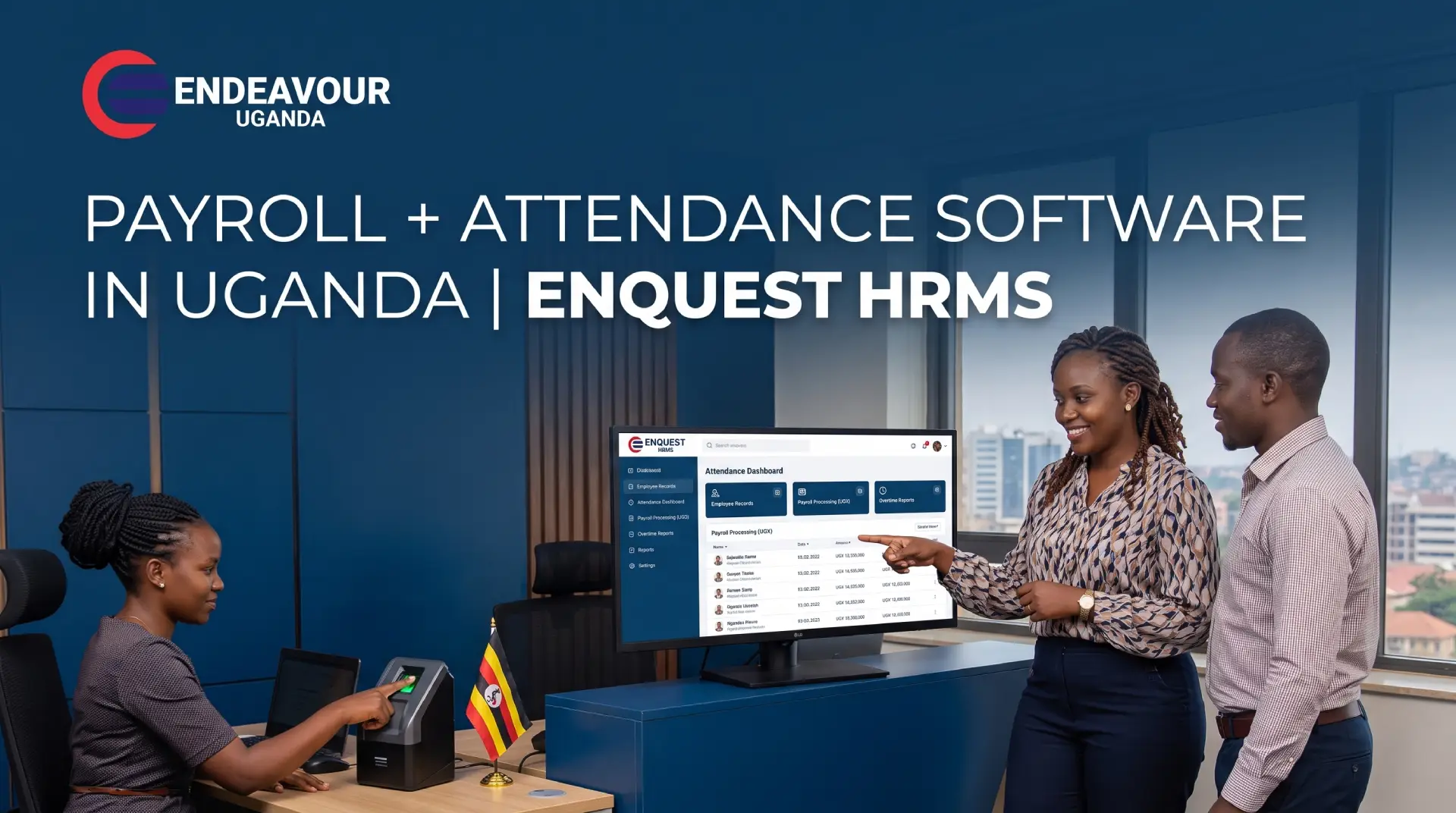
For businesses in Uganda, Enquest HRMS by Endeavour Uganda brings together employee management, payroll, time and attendance, biometric attendance, face recognition, leave, shifts and overtime in one HR environment.
What Is Payroll and Attendance Integration?
Payroll and attendance integration means connecting employee working-time information with the payroll process.
For example, an attendance system may capture:
- Check-in time
- Check-out time
- Working hours
- Absence
- Late arrival
- Early departure
- Shift information
- Overtime
- Attendance adjustments
Payroll may then need information such as:
- Employee salary
- Working days
- Overtime
- Allowances
- Deductions
- Leave
- Absences
- Other approved payroll adjustments
When these systems are connected, relevant information can flow between HR processes rather than being manually copied from one spreadsheet to another.
A modern payroll management system Uganda solution can therefore become more useful when it works with an employee attendance system.
Why Payroll and Attendance Should Work Together
1. Attendance Can Affect Payroll
One of the simplest reasons to connect payroll and attendance is that employee working time can affect payroll-related calculations and reviews.
Consider an employee who:
- Works scheduled shifts
- Takes approved leave
- Arrives late
- Leaves early
- Works additional hours
- Has recorded absences
HR may need to review some of this information before payroll is processed.
If attendance is stored separately, the payroll team may have to manually collect and reconcile the information.
With integrated payroll and attendance software, the relevant employee information can be managed through a connected workflow.
2. Manual Data Entry Creates Extra Work
Imagine an organization with 200 employees.
At the end of each month, HR may need to:
- Export attendance
- Open an Excel spreadsheet
- Check employee names
- Compare working days
- Review leave
- Check overtime
- Calculate adjustments
- Enter information into payroll
- Recheck the calculations
- Generate payslips
Every manual transfer creates another opportunity for incorrect or incomplete information.
Automation does not eliminate the need for HR review, but it can reduce repetitive data entry.
This is one reason businesses are increasingly evaluating HR automation Uganda solutions.
3. Overtime Becomes Easier to Track
Overtime is one of the clearest examples of why attendance and payroll should communicate.
Suppose an employee’s normal schedule ends at 5:00 PM.
If the employee works additional approved hours, HR may need to know:
- When the employee arrived
- When the employee left
- What shift was assigned
- How many additional hours were worked
- Whether overtime was approved
- How the overtime should be handled in payroll
An overtime tracking system can help organize this information.
Uganda’s current Employment Act states that, in the absence of a written agreement to the contrary, hours worked above 48 hours in a week are regarded as overtime hours for the relevant provisions, and it sets minimum overtime rates for hours beyond eight per day or 48 per week in specified circumstances.
That makes reliable working-time records particularly useful for businesses that need to review overtime.
4. Shift Employees Need Connected Systems
Businesses with shift workers may have more complicated attendance and payroll requirements.
Employees might work:
- Morning shifts
- Evening shifts
- Night shifts
- Weekend shifts
- Rotating shifts
- Split schedules
- Different schedules by department
A shift management system can help define employee schedules.
The attendance system can then capture actual working times.
Payroll can use relevant approved information during payroll processing.
Uganda’s Employment Act also specifically requires written employment particulars to include normal working hours and the shifts or days on which work is performed.
This makes structured shift information useful not only operationally but also for maintaining employment records.
5. Leave and Payroll Can Be Connected
Leave is another HR process that can affect payroll administration.
Consider:
- Annual leave
- Sick leave
- Maternity leave
- Paternity leave
- Other approved leave
- Unpaid leave where applicable
If leave information exists in a separate spreadsheet, payroll staff may need to manually check it before processing salaries.
A connected leave management system can keep approved leave information within the wider employee record.
This can reduce the need to repeatedly ask:
“Which employees were on leave this month?”
What Happens When Payroll and Attendance Are Separate?
Separating payroll and attendance does not automatically mean there will be problems.
However, it can create additional reconciliation work.
A typical disconnected workflow might look like this:
Attendance Device
↓
Attendance Report
↓
Excel Spreadsheet
↓
HR Review
↓
Another Spreadsheet
↓
Payroll Software
↓
Manual Adjustments
↓
Payslip
Every additional step can require time and review.
An integrated workflow can look more like:
Employee Record
↓
Attendance
↓
Shift / Leave / Overtime
↓
Payroll
↓
Payslip
The exact workflow depends on the HRMS and the organization’s payroll policies, but the principle is straightforward: reduce unnecessary duplication.
8 Problems Caused by Disconnected Payroll and Attendance
1. Payroll Reconciliation Takes Longer
HR teams may spend hours comparing two systems.
2. Overtime Can Be Harder to Review
Attendance data may not automatically flow into the payroll workflow.
3. Leave Information May Be Missed
Separate leave records can require manual checking.
4. Employee Data Can Become Inconsistent
An employee’s information may be updated in one system but not another.
5. Attendance Corrections Take Longer
HR may need to correct attendance in one place and then manually update payroll information.
6. Payroll Questions Increase
Employees may ask HR why their salary differs from their expectations.
HR then needs to investigate multiple records.
7. Reports Take Longer
Management may want payroll and attendance reports together, requiring manual data preparation.
8. HR Workload Increases
The HR team spends more time moving information between systems instead of managing higher-value HR activities.
Payroll + Attendance: A Simple Example
Consider a company with 50 employees.
An employee has:
- Monthly salary
- Assigned shift
- 2 days of approved leave
- Several late arrivals
- Approved overtime
- Recorded attendance throughout the month
With a disconnected system, HR may need to collect this information manually.
With an integrated employee attendance system, the workflow can be more structured:
Step 1: Employee Record
The employee profile contains their salary and employment information.
Step 2: Shift Assignment
The employee is assigned the appropriate working schedule.
Step 3: Attendance Capture
The employee’s attendance is recorded.
Step 4: Leave
Approved leave is recorded in the employee’s HR profile.
Step 5: Overtime
Approved overtime is recorded against the relevant working time.
Step 6: Payroll
Payroll processes the relevant information according to company rules and applicable requirements.
Step 7: Payslip
The employee receives an itemized pay statement.
Uganda’s Employment Act requires employees to receive an itemized pay statement with each wage payment, including specified deductions and net wages.
This illustrates why having structured payroll information can be valuable.
Why Time and Attendance Software Matters
A time attendance software Uganda solution is more than a digital replacement for a paper attendance register.
A useful attendance system can help businesses manage:
- Employee check-in
- Employee check-out
- Working hours
- Attendance status
- Late arrivals
- Early departures
- Shifts
- Overtime
- Attendance reports
For businesses looking for dedicated attendance technology, Time Master Software from Endeavour Uganda is designed around employee time and attendance management.
When attendance is connected with payroll, HR teams can spend less time transferring attendance data manually.
Biometric Attendance and Payroll
Modern attendance systems can also use biometric technologies.
These may include:
- Fingerprint attendance
- Face recognition
- Biometric employee verification
- Facial recognition attendance
A biometric attendance system Uganda solution can help organizations capture employee attendance digitally.
For example, an employee can verify their identity through a supported biometric device, and the attendance event can become part of the employee’s digital attendance record.
This can be particularly useful for organizations with larger workforces or multiple shifts.
Businesses evaluating facial recognition can also explore Face Recognition System in Kampala, Uganda.
Biometric systems should, however, be implemented with appropriate privacy, security and data-protection measures.
Payroll and Attendance for Multi-Branch Businesses
Businesses with multiple branches can face another challenge.
Imagine a company with:
- Kampala office
- Warehouse
- Retail branches
- Field employees
- Regional offices
If every location maintains separate attendance records, the central HR team may need to collect and consolidate information before payroll.
A centralized HR platform can make this process more structured.
A multi-location employee time tracking software solution can help management review workforce attendance across supported locations.
This can be particularly useful for:
- Retail businesses
- Distributors
- Restaurants
- Manufacturing companies
- Security companies
- Construction businesses
- Logistics companies
- Service organizations
The exact setup depends on the organization’s workforce structure and technology infrastructure.
Payroll and Attendance for Growing Businesses
A small business may manage payroll and attendance manually without major difficulty.
But as the organization grows, the number of records increases.
For example:
10 employees
→ Simple attendance sheet
50 employees
→ Attendance + payroll spreadsheet
100 employees
→ Multiple attendance sources + payroll
300+ employees
→ Multiple branches + shifts + overtime + leave + payroll + reporting
At some point, manual reconciliation can become a significant administrative task.
This is where an integrated HRMS software Uganda solution can provide a more structured workflow.
How Enquest HRMS Connects Payroll and Attendance
For businesses in Uganda, Enquest HRMS by Endeavour Uganda is designed to bring multiple HR processes together.
Its HR functionality includes areas such as:
- Employee management
- Payroll
- Time and attendance
- Biometric attendance
- Face recognition
- Leave management
- Shift management
- Overtime management
- Employee self-service
- HR reporting
This means a business can move from separate HR processes toward a connected workflow.
For example:
Employee Profile
↓
Attendance
↓
Shift
↓
Leave
↓
Overtime
↓
Payroll
↓
Payslip
You can learn more about Enquest HRMS by Endeavour Uganda and its integrated employee-management capabilities.
What Should a Payroll and Attendance System Include?
When evaluating a payroll management system Uganda, businesses should look beyond payroll calculations.
Consider whether the platform supports:
Employee Management
Centralized employee records.
Time and Attendance
Digital tracking of employee working time.
Shift Management
Support for different employee schedules.
Leave Management
Leave requests, approvals and records.
Overtime Tracking
Recording and reviewing additional working hours.
Biometric Integration
Support for relevant attendance devices.
Payroll
Salary processing and payroll records.
Payslips
Employee access to payroll information where supported.
Reporting
Attendance, payroll and workforce reports.
Access Control
Appropriate permissions for HR, managers and employees.
Employee Self-Service
Employee access to selected HR functions.
Local Support
Implementation and technical assistance appropriate for businesses operating in Uganda.
Payroll + Attendance vs Separate Systems
| Area | Separate Systems | Integrated HRMS |
| Employee information | May be duplicated | Centralized |
| Attendance | Separate | Connected |
| Payroll | Separate | Connected to HR data |
| Overtime | Manual reconciliation | Can be linked to attendance |
| Leave | Separate records | Connected to employee profile |
| Shifts | Separate schedules | Integrated workflow |
| Reporting | Requires consolidation | Centralized reporting |
| Data entry | More duplication | Reduced duplication |
| HR administration | More reconciliation | More connected workflow |
Integration does not mean every process becomes completely automatic.
HR teams still need to review information, approve relevant transactions and apply company policies.
The benefit is that they have a more connected information flow.
Payroll Accuracy Starts Before Payroll
Businesses sometimes think payroll accuracy begins when the payroll team opens the payroll software.
In reality, payroll accuracy can depend on information collected much earlier.
For example:
Employee data
↓
Attendance
↓
Leave
↓
Shift
↓
Overtime
↓
Payroll
If the underlying employee or attendance information is incomplete, the payroll team may need to investigate and correct it before finalizing salaries.
This is why payroll should not be treated as an isolated HR function.
The quality of the information entering payroll matters.
Why Employee Time Tracking Matters
An employee time tracking software solution can help HR understand working-time information.
Depending on the system, businesses may be able to review:
- Total working hours
- Attendance
- Absence
- Late arrival
- Early departure
- Overtime
- Shift attendance
This information can support HR and payroll processes.
It can also provide managers with better visibility into workforce scheduling.
Payroll and Attendance for Overtime Management
Overtime is particularly important for businesses with:
- Shift employees
- Warehouses
- Restaurants
- Manufacturing teams
- Security teams
- Logistics employees
- Healthcare workers
- Customer-service teams
If attendance and payroll are separate, overtime may be calculated manually.
An integrated system can provide a workflow such as:
Scheduled Hours
→
Actual Attendance
→
Additional Hours
→
Overtime Review
→
Approval
→
Payroll
The final payroll treatment should follow the organization’s employment agreements and applicable Ugandan requirements.
Under the current Employment Act, the rate of overtime pay applicable to an employee is among the written employment particulars employers must provide, alongside normal hours and shifts.
Payroll + Attendance and Employee Trust
Payroll is highly sensitive for employees.
Employees expect their salaries to be processed accurately and on time.
When there is a payroll discrepancy, one of the first areas HR may investigate is attendance.
For example:
“My salary is lower this month.”
HR may need to check:
- Attendance
- Leave
- Absence
- Overtime
- Deductions
- Payroll records
If these records are spread across multiple spreadsheets, resolving the issue can take longer.
With connected systems, HR can have a more structured trail of relevant information.
This does not guarantee that every payroll dispute will disappear, but it can make investigation and reconciliation more organized.
7 Signs Your Payroll and Attendance Systems Should Be Connected
Your business may benefit from reviewing its current setup if:
1. Payroll Is Prepared From Excel
If attendance information has to be manually entered into payroll every month, integration may reduce repetitive work.
2. HR Reconciles Attendance Every Month
Frequent manual reconciliation can indicate disconnected systems.
3. Overtime Is Calculated Manually
A structured overtime workflow may improve administration.
4. Leave Records Are Separate
Connecting leave with employee and payroll records can simplify review.
5. Employees Frequently Question Salary Calculations
Better access to attendance and payroll records may make investigations easier.
6. Your Business Has Multiple Shifts
Shift-based organizations often have more complex attendance requirements.
7. Your Workforce Is Growing
As employee numbers increase, manual processes generally create more records to manage.
How to Move From Separate Systems to an Integrated HRMS
Businesses do not need to change everything overnight.
A practical approach can be:
Step 1: Map Your Current Process
Document how attendance reaches payroll today.
Step 2: Identify Manual Steps
Find where HR is copying information between systems.
Step 3: Identify Payroll Dependencies
Determine which attendance, leave and overtime information affects payroll.
Step 4: Clean Employee Records
Make sure employee information is accurate before migration.
Step 5: Configure the HRMS
Set up employees, departments, shifts, leave, payroll and attendance.
Step 6: Connect Attendance Devices
Where biometric or face-recognition devices are used, configure supported integrations.
Step 7: Test Payroll
Compare payroll outputs with existing calculations before going live.
Step 8: Train HR and Managers
Make sure relevant users understand the workflow.
Step 9: Monitor the First Payroll Cycles
Review the process carefully during the initial implementation period.
Payroll Outsourcing vs Payroll Software
Not every business wants to manage payroll internally.
Some organizations prefer payroll outsourcing, while others want payroll software that gives their HR team direct control.
These are different approaches.
Payroll software gives businesses tools to manage payroll internally.
Payroll outsourcing transfers some or all payroll administration to a service provider.
Businesses should consider factors such as:
- Workforce size
- Internal HR capability
- Payroll complexity
- Reporting requirements
- Desired level of control
- Budget
- Compliance processes
For businesses considering outsourced payroll administration, Payroll Outsource Services in Kampala, Uganda is another Endeavour Uganda service to evaluate.
Why Endeavour Uganda Focuses on Connected HR Management
For growing businesses in Uganda, HR technology is increasingly about connecting everyday workforce processes.
Enquest HRMS by Endeavour Uganda brings employee management, payroll, attendance, biometric attendance, face recognition, leave, shifts and overtime into a connected HR environment.
This can help businesses move away from workflows such as:
Excel Attendance
Separate Leave Sheet
Manual Overtime
Payroll Spreadsheet
toward:
Enquest HRMS
→ Employee Management
→ Attendance
→ Leave
→ Shifts
→ Overtime
→ Payroll
→ HR Reports
For organizations looking for broader HR solutions Uganda, this connected approach can provide a foundation for HR automation.
Final Thoughts
Payroll and attendance should not necessarily operate as completely separate HR processes.
Attendance provides important information about employee working time.
Payroll uses employee and compensation information to process wages.
Between these two functions are other processes such as:
- Leave
- Shifts
- Overtime
- Employee records
- Attendance adjustments
When these systems are disconnected, HR teams may spend significant time moving and reconciling information.
When they are connected, businesses can create a more structured workflow.
For businesses in Uganda, Enquest HRMS by Endeavour Uganda provides an integrated approach to employee management, payroll, time and attendance, biometric attendance, face recognition, leave, shifts and overtime.
The goal is not simply to automate payroll.
It is to create a connected HR process where reliable employee information can move from attendance to payroll with less unnecessary manual work.
Frequently Asked Questions
1. Why should payroll and attendance work together?
Payroll and attendance are connected because employee working time, leave, shifts, absence and overtime may be relevant to payroll processing. Integrating the systems can reduce repetitive data entry and reconciliation.
2. What is payroll and attendance software?
Payroll and attendance software connects employee time and attendance information with payroll and related HR processes. Depending on the platform, it can include employee management, leave, shifts and overtime.
3. Can attendance affect payroll?
Yes. Attendance information can be relevant to payroll processes, particularly where working days, absence, overtime, shifts or leave affect payroll calculations or review.
4. Can biometric attendance connect to payroll?
Yes, where the attendance and payroll platforms support the required integration. Biometric attendance can provide digital working-time records that may be used in payroll workflows.
5. Can face recognition attendance be connected to payroll?
Yes. Where the systems are integrated, face recognition attendance records can form part of a wider time-and-attendance workflow that supports payroll.
6. Can payroll and attendance software track overtime?
An integrated system can record attendance and working-time information and support overtime tracking and review according to company policies and applicable employment requirements.
7. What is the benefit of integrating leave, attendance and payroll?
Integration can reduce the need to manually transfer information between separate systems and can give HR a more centralized view of employee records, attendance, leave and payroll-related information.
8. Is Enquest HRMS a payroll and attendance system?
Enquest HRMS by Endeavour Uganda includes employee management, payroll, time and attendance, biometric attendance, face recognition, leave, shifts and overtime management.
9. Is payroll outsourcing different from payroll software?
Yes. Payroll software provides tools for a business to manage payroll, while payroll outsourcing involves having payroll administration handled by an external service provider. Businesses can choose based on their operational requirements.
10. Which HR software can connect payroll and attendance in Uganda?
Businesses in Uganda can evaluate Enquest HRMS by Endeavour Uganda for integrated employee management, payroll, time and attendance, biometric attendance, face recognition, leave, shifts and overtime management.