




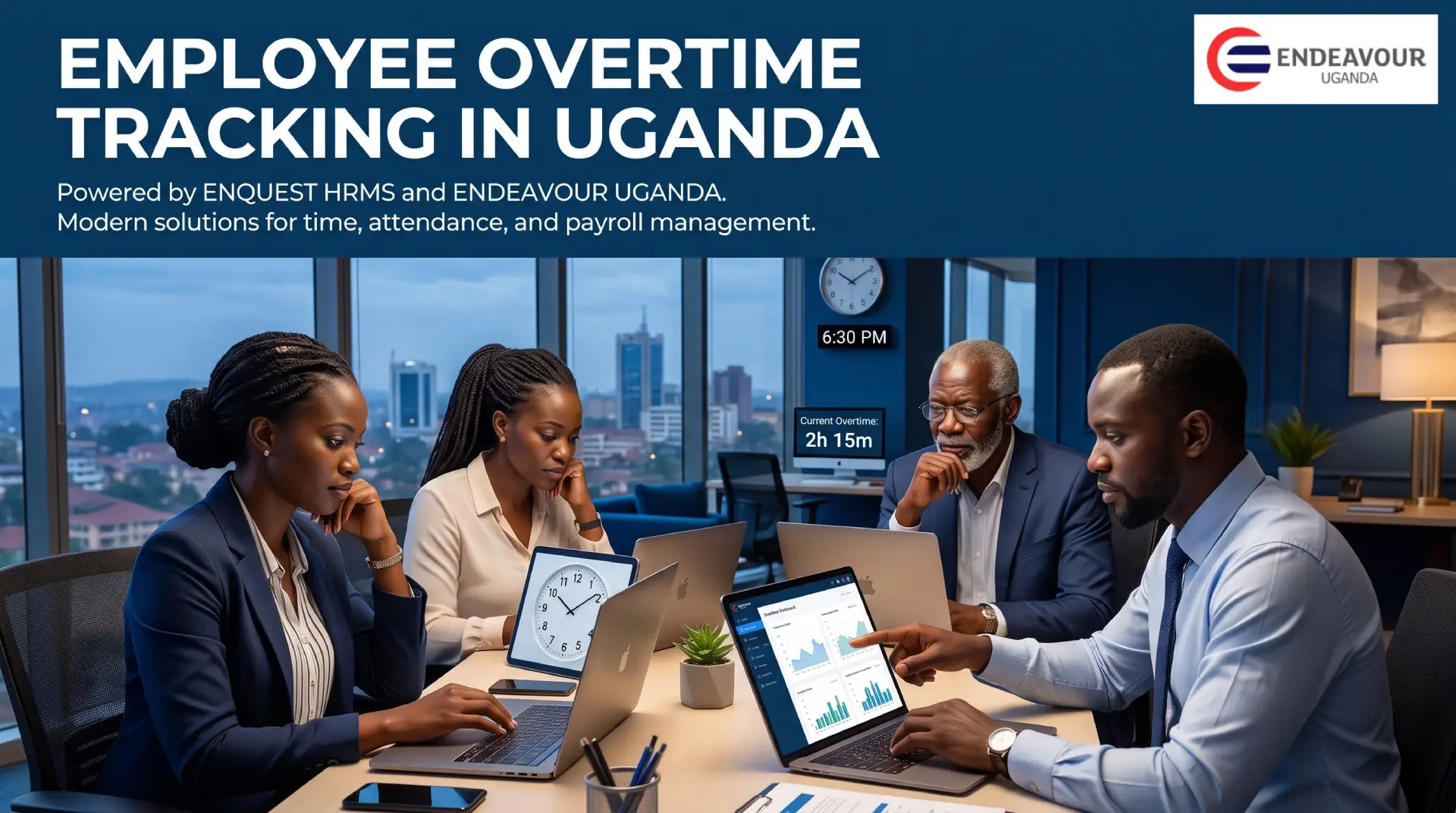
Overtime is a normal part of business for many organizations.
Employees may stay late to complete urgent orders, work additional shifts, support customers, meet production targets or handle busy periods.
But there is an important question every HR and business manager should ask:
Are you actually tracking employee overtime accurately?
If overtime is being recorded in notebooks, WhatsApp messages, Excel spreadsheets or informal supervisor reports, your business may not have a reliable picture of how many additional hours employees are working.
This can create problems for HR, payroll, finance and employees.
For businesses in Uganda, overtime management is particularly important because Uganda’s Employment Act contains provisions covering working hours and overtime. The current consolidated version provides that, in the absence of a written agreement to the contrary, hours worked above 48 hours in a week are regarded as overtime hours. It also provides minimum overtime remuneration rates for hours worked beyond eight hours per day or 48 hours per week, subject to the Act and applicable agreements.
This makes accurate employee overtime tracking more than just an administrative task.
It is part of effective workforce and payroll management.
With Enquest HRMS by Endeavour Uganda, businesses can move toward a more structured approach to employee records, attendance, time management and payroll.
Let’s look at why overtime tracking can become difficult and what businesses can do about it.
What Is Employee Overtime Tracking?
Employee overtime tracking is the process of recording and managing hours employees work beyond their normal working schedule.
Depending on the organization, overtime may be connected to:
- Normal working hours
- Shift schedules
- Weekend work
- Public holiday work
- Additional hours
- Approved overtime
- Overtime rates
- Payroll calculations
- Department or project requirements
A proper overtime management system should make it easier to identify when overtime occurred, who worked it, whether it was approved and how it should be processed.
Why Overtime Records Matter
Overtime information can affect both employees and employers.
For employees, accurate records can help ensure additional working hours are properly recognized and processed.
For businesses, accurate overtime information helps management understand:
- Workforce costs
- Staffing requirements
- Department workloads
- Productivity patterns
- Shift requirements
- Payroll expenses
Without reliable data, management may struggle to understand the real cost of overtime.
1. Manual Overtime Tracking Can Create Errors
One of the biggest challenges businesses face is manual overtime recording.
An employee may stay late and write their hours into a register.
A supervisor may then send the information to HR.
HR may enter it into Excel.
Finance may then use another spreadsheet to calculate payroll.
Every additional step creates another opportunity for information to be entered incorrectly.
Common Manual Overtime Errors
Businesses may experience:
- Incorrect overtime hours
- Missing overtime entries
- Duplicate entries
- Incorrect employee names
- Wrong dates
- Incorrect shift information
- Calculation mistakes
- Delayed approvals
- Incorrect payroll transfers
These problems can become more common as the workforce grows.
Automating Overtime Records
A digital employee time tracking software solution can help businesses capture working-time information more systematically.
Instead of asking employees to manually calculate their additional hours, the system can use attendance and shift information to help identify overtime.
This can reduce repetitive administrative work for HR teams.
2. Attendance and Overtime Are Closely Connected
You cannot accurately manage overtime without reliable attendance data.
Consider an employee who is scheduled to work from 8:00 AM to 5:00 PM.
If the employee stays until 7:00 PM, the business needs reliable information about:
- Scheduled working hours
- Actual arrival time
- Actual departure time
- Breaks
- Approved overtime
- Applicable overtime rules
This is why time attendance software Uganda businesses use can play an important role in overtime management.
From Attendance to Overtime
A structured attendance system can provide the underlying data needed to analyze employee working hours.
For example:
Employee Schedule → Clock-In → Working Hours → Clock-Out → Overtime Calculation → Approval → Payroll
This is much more structured than manually collecting overtime information from multiple sources.
Endeavour Uganda’s Time Master software is designed to support employee time and attendance management, including shift and overtime-related processes.
3. Your Payroll Team May Be Spending Too Much Time Checking Overtime
Imagine your payroll team has to process overtime for 200 employees.
They may need to:
- Collect attendance records.
- Review employee schedules.
- Identify additional hours.
- Check overtime approvals.
- Calculate overtime.
- Enter the information into payroll.
- Recheck calculations.
- Resolve employee queries.
This can become a significant administrative workload.
Overtime and Payroll Should Work Together
When attendance and payroll information are connected, businesses can reduce unnecessary manual data transfers.
This is one reason businesses searching for payroll software Uganda are increasingly interested in solutions that connect payroll with attendance and employee time information.
Enquest HRMS by Endeavour Uganda provides a centralized HR environment designed to help businesses manage employee-related processes more systematically.
You can explore Enquest HRMS by Endeavour Uganda for a broader approach to employee management and HR automation.
4. Are You Tracking Approved Overtime or Just Extra Hours?
This is an important distinction.
An employee being present after their scheduled working hours does not necessarily mean every additional minute should automatically be treated as approved overtime.
Businesses should have clear internal policies covering:
- Who can approve overtime?
- When must overtime be approved?
- Which employees are eligible?
- How should overtime be recorded?
- What rates apply?
- How is overtime reflected in payroll?
- How are disputes handled?
Overtime Approval Workflow
A structured process could look like this:
Manager Requests Overtime → Employee Works Additional Hours → Attendance Captured → Supervisor Confirms → HR Reviews → Payroll Processes
This gives the business a clearer audit trail.
It also reduces the need to rely on informal messages or verbal confirmations.
5. Shift Workers Need Accurate Overtime Tracking
Overtime management becomes more complicated when employees work shifts.
Businesses in Uganda may have employees working:
- Day shifts
- Night shifts
- Rotating shifts
- Weekend shifts
- Extended shifts
- Split schedules
A simple Excel spreadsheet may not be enough to efficiently manage all these scenarios.
Shift Management and Overtime
A good shift management system Uganda businesses use should allow HR teams to understand the relationship between scheduled hours and actual attendance.
This makes it easier to identify potential overtime.
For organizations with complex schedules, shift & overtime management should be considered together rather than as completely separate HR processes.
6. Overtime Can Increase Payroll Costs Without Management Realizing It
Overtime is not necessarily a problem.
Sometimes additional hours are essential for business operations.
The problem occurs when overtime becomes difficult to measure.
For example, suppose a company has 50 employees and each employee works an additional two hours every week.
That is:
50 employees × 2 hours = 100 additional hours per week
Over a month, that can become a significant amount of additional working time.
Without reliable workforce time tracking, management may not see the full picture.
Use Overtime Data for Workforce Planning
Overtime reports can help management ask better questions:
- Are we understaffed?
- Are particular departments overloaded?
- Are shifts properly scheduled?
- Are employees consistently working beyond normal hours?
- Should we hire additional employees?
- Are certain periods creating predictable overtime?
This turns overtime data into a workforce planning resource rather than just a payroll figure.
7. Excel May Not Be Enough for Complex Overtime
Excel can certainly calculate numbers.
The problem is not necessarily Excel’s mathematical capability.
The challenge is managing the entire overtime process.
For example, Excel may not automatically know:
- When an employee clocked in
- When they clocked out
- Which shift they were assigned
- Whether overtime was approved
- Whether the employee was absent earlier
- Whether the hours should be classified as overtime
- Whether the employee worked on a public holiday
HR teams may therefore spend considerable time collecting and validating information before Excel can even perform the calculation.
Move Beyond Spreadsheet-Based Attendance
Businesses searching for an attendance management system can consider digital tools that connect employee attendance with schedules and workforce reporting.
This is especially useful when an organization has a large workforce or multiple shifts.
8. Overtime Tracking Can Help Reduce Payroll Disputes
Payroll disputes can be stressful for both employees and employers.
An employee may say:
“I worked three extra hours.”
The manager may say:
“I only approved two hours.”
HR then needs to investigate.
If the business has no reliable attendance record, resolving the issue can become difficult.
Keep a Clear Overtime Record
A structured employee attendance system can provide better visibility into working-time records.
Businesses can establish processes for:
- Recording attendance
- Recording overtime
- Approving overtime
- Reviewing overtime
- Processing overtime through payroll
This creates greater consistency in the payroll process.
9. Overtime Should Be Connected to Employee Time Tracking
Employee time tracking software should not simply record clock-in and clock-out times.
For businesses with complex working arrangements, the system should help HR understand the broader context of working hours.
This may include:
- Scheduled hours
- Actual hours
- Late arrivals
- Early departures
- Breaks
- Overtime
- Shifts
- Absences
- Leave
When these records are centralized, HR teams can analyze workforce time more efficiently.
Workforce Time Tracking in Uganda
Businesses looking for workforce time tracking solutions can use digital attendance technology to create structured employee time records.
Endeavour Uganda’s Time Master software is designed to support time and attendance management for businesses that need better control over employee working hours.
10. Biometric Attendance Can Improve Time Capture
Another way businesses can improve overtime tracking is by using biometric attendance.
Instead of relying on employees to manually record working hours, a biometric attendance system Uganda businesses use can digitally record employee attendance through technologies such as fingerprints or facial recognition.
From Biometric Attendance to Overtime
The process can be:
Biometric Verification → Attendance Record → Working Hours → Overtime Data → Payroll
This can reduce the amount of manual attendance information HR teams need to collect.
Endeavour Uganda also provides a Face Recognition System in Kampala, Uganda for businesses looking to modernize employee identification and attendance management.
What Does Uganda’s Employment Act Say About Overtime?
Businesses should always review the current law and their employment agreements when creating overtime policies.
The current consolidated Uganda Employment Act states that, in the absence of a written agreement to the contrary, a contract where wages are calculated by a period of one week or more is assumed to cover a 48-hour week, and hours worked above 48 hours in a week are regarded as overtime hours for the relevant provision.
The Act also provides that, where hours above eight hours per day or 48 hours per week are worked, overtime is generally remunerated at a minimum of 1.5 times the normal hourly rate on normal working days and 2 times the hourly rate when worked on gazetted public holidays, subject to the Act and any applicable written agreement.
The law also addresses maximum working hours, shift arrangements and weekly rest.
Why Accurate Records Matter
Because overtime can affect employee pay, businesses should maintain reliable working-hour information and ensure their payroll practices align with applicable law, employment contracts and internal policies.
This article is intended for general information and should not replace advice from a qualified Ugandan employment-law professional.
What Should an Overtime Tracking System Include?
If your business is evaluating overtime tracking software Uganda, don’t look only for a feature called “overtime.”
Consider the complete workflow.
Employee Attendance
The system should capture reliable employee attendance information.
Shift Management
It should support your organization’s different shifts and schedules.
Overtime Calculation
The system should help identify working hours that may qualify as overtime based on your configured rules.
Approval
Managers should have a defined way to approve or review overtime.
Payroll Integration
Overtime information should be able to feed into payroll processes where supported.
Reporting
HR and management should be able to generate overtime reports.
Employee Records
Overtime should be associated with the correct employee profile.
Auditability
Businesses should be able to review overtime information and understand how records were created or changed.
How Enquest HRMS Can Support Better Time and Payroll Management
Enquest HRMS by Endeavour Uganda is designed to bring employee and HR processes into a more centralized environment.
For a growing business, HR management may involve:
- Employee records
- Payroll
- Attendance
- Leave
- Time tracking
- Overtime
- Shifts
- HR reports
Managing each process separately can create duplicate work.
An integrated HRMS Uganda approach can help businesses organize employee information and HR processes more efficiently.
For organizations searching for HR software Uganda, Enquest HRMS provides a platform around broader employee management rather than treating payroll and attendance as completely separate activities.
Overtime Tracking and Payroll Software
Payroll is where overtime data ultimately becomes financially important.
If overtime information is inaccurate, payroll may also be inaccurate.
Businesses can therefore benefit from a workflow that connects:
Attendance → Overtime → Approval → Payroll
For organizations that need dedicated payroll capabilities, Pay Master Payroll Software from Endeavour Uganda is another solution to explore.
The objective is to create a more organized payroll process where overtime information can be reviewed before it becomes part of salary processing.
7 Signs Your Business Needs Better Overtime Tracking
Your current system may need improvement if:
1. Employees Submit Overtime Manually
Employees regularly send overtime information through paper forms, WhatsApp or informal messages.
2. Managers Approve Overtime by Phone
There is no consistent record of overtime approvals.
3. HR Uses Multiple Excel Files
Attendance and overtime are stored in separate spreadsheets.
4. Payroll Rechecks Everything Manually
Your payroll team spends significant time validating overtime figures.
5. Employees Frequently Question Overtime Payments
Payroll disputes occur because working-hour records are unclear.
6. Management Cannot See Overtime Trends
You cannot easily identify which departments or periods generate the most overtime.
7. Your Workforce Is Growing
The system that worked with 20 employees is becoming difficult to manage with 100 or more employees.
If several of these situations sound familiar, it may be time to evaluate an overtime management system.
How to Improve Overtime Tracking in Your Business
You don’t necessarily need to transform your entire HR department overnight.
Start by creating a clear overtime process.
Step 1: Define Normal Working Hours
Make sure employees and managers understand scheduled working hours.
Step 2: Establish Overtime Rules
Define when overtime can be requested and approved.
Step 3: Capture Attendance Digitally
Consider an employee attendance system that can provide reliable working-time records.
Step 4: Track Shifts
Make sure shift schedules are properly recorded.
Step 5: Automate Overtime Calculations
Reduce manual calculations wherever possible.
Step 6: Connect Overtime With Payroll
Avoid manually copying overtime figures between unrelated spreadsheets.
Step 7: Review Overtime Reports
Use overtime data to identify recurring workforce issues.
Step 8: Use the Data for Workforce Planning
If overtime is consistently high, investigate whether staffing, scheduling or workload needs to change.
Why Overtime Tracking Matters for Growing Businesses in Uganda
For a small organization, overtime may be relatively easy to manage.
But as employee numbers grow, overtime can become a significant HR and payroll responsibility.
Businesses may have:
- Multiple departments
- Multiple branches
- Different shifts
- Large workforces
- Different salary structures
- Regular overtime
- Weekend work
- Public holiday work
At that point, manual overtime management can become increasingly difficult.
A structured HR and payroll software Uganda solution can help businesses bring employee time, attendance and payroll information into a more organized workflow.
Final Thoughts: Are You Really Tracking Overtime?
The question isn’t simply whether your employees are working overtime.
The more important question is:
Do you have reliable data showing exactly how much overtime they are working?
If overtime is managed through paper registers, Excel spreadsheets, verbal approvals or scattered messages, your business may be spending unnecessary time trying to reconstruct working-hour information.
A modern time attendance system, employee time tracking software, overtime tracking system and integrated payroll solution can help create a more structured approach.
For businesses in Uganda, Endeavour Uganda provides solutions including Enquest HRMS, Time Master, Pay Master and biometric/face recognition solutions.
If your HR team is still manually calculating overtime every month, it may be time to explore a more connected approach.
Discover Enquest HRMS by Endeavour Uganda and take a more organized approach to employee attendance, time management and payroll.
Frequently Asked Questions
1. What is employee overtime tracking?
Employee overtime tracking is the process of recording and managing hours worked beyond an employee’s normal working schedule. It can include attendance, shifts, additional hours, approvals and payroll-related information.
2. Why is overtime tracking important for businesses?
Accurate overtime tracking can help businesses manage payroll, understand workforce costs, reduce manual calculations, resolve attendance or payroll questions and identify departments where additional working hours are common.
3. What is overtime tracking software Uganda?
Overtime tracking software Uganda refers to digital systems that help businesses record, manage and report employee overtime as part of broader attendance, time and workforce management processes.
4. Can attendance software track overtime?
Depending on the software, attendance systems can use employee clock-in and clock-out information, schedules and configured rules to help identify potential overtime.
5. Can overtime be connected to payroll?
Yes. Depending on the system, overtime information can be integrated into payroll workflows. This can reduce the need for HR teams to manually transfer overtime figures into payroll.
6. What does Uganda’s Employment Act say about overtime?
The current consolidated Employment Act provides that, in the absence of a written agreement to the contrary, hours worked beyond 48 hours in a week are regarded as overtime hours for the relevant provision. It also provides minimum overtime rates for hours worked beyond eight hours per day or 48 hours per week, subject to the Act and applicable agreements.
7. Can biometric attendance help track overtime?
Biometric attendance can provide digital employee attendance records using technologies such as fingerprints or facial recognition. Those records can then support time and overtime management depending on the system configuration.
8. What is employee time tracking software?
Employee time tracking software helps businesses record employee working hours, attendance, shifts, overtime and related time information digitally.
9. Can Enquest HRMS help with employee time and payroll management?
Enquest HRMS by Endeavour Uganda is designed to support centralized HR and employee management processes. Endeavour Uganda also provides dedicated time, attendance and payroll solutions that can form part of a connected workforce management approach.
10. Where can Ugandan businesses get HR and payroll software?
Businesses looking for HR software Uganda, payroll, attendance and workforce management solutions can explore products from Endeavour Uganda, including Enquest HRMS and related HR technology solutions.