




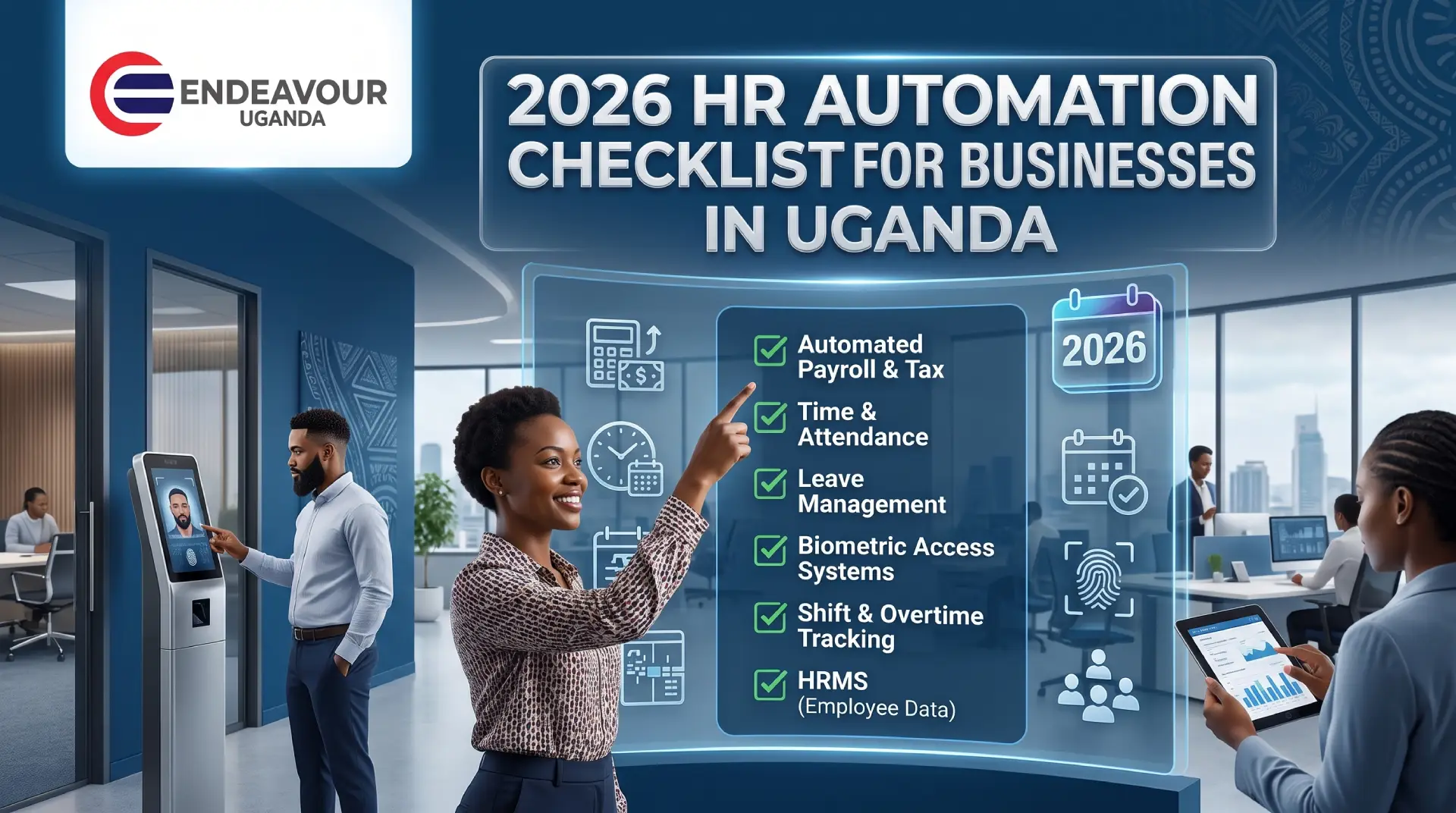
Managing HR manually can become increasingly difficult as a business grows. Employee records, payroll, attendance, leave, shifts and overtime can quickly create a large amount of administrative work.
In 2026, businesses are increasingly looking at HR technology and automation to simplify these processes. SHRM’s 2026 research shows that AI adoption in HR is growing, although implementation remains uneven and organizations are focusing on practical use cases rather than technology for its own sake.
For growing businesses in Uganda, HR automation does not have to mean introducing complicated technology overnight. The best approach is to start with the HR processes that take the most time and gradually build a more connected system.
What Is HR Automation?
HR automation means using software to handle repetitive human resource tasks digitally.
Instead of relying on spreadsheets, paper files, emails and manual calculations, businesses can use an HRMS or HR software Uganda solution to organize important HR activities in one place.
Common areas that can be automated include:
- Employee records
- Payroll
- Time and attendance
- Leave management
- Shift management
- Overtime tracking
- Employee self-service
- HR reporting
For businesses that are growing, this can make HR administration easier to manage and reduce repetitive work.
The 2026 HR Automation Checklist
1. Centralize Employee Records
The first step in HR automation is getting employee information organized.
Instead of keeping employee details across different spreadsheets and physical files, businesses can use a centralized employee management system Uganda solution.
A centralized system can help HR teams manage employee profiles, departments, positions, employment information and other important records.
With Enquest HRMS by Endeavour Uganda, businesses can bring important employee information into a more organized HR environment.
2. Automate Payroll Management
Payroll is one of the most important HR processes to automate.
Manual payroll processing can involve repeated calculations, checking attendance, managing deductions and preparing salary information.
A payroll software Uganda solution can help businesses organize payroll processes and reduce repetitive administrative work.
Businesses can also explore Pay Master Payroll Software for payroll management.
3. Connect Payroll With Attendance
Payroll and attendance are closely connected.
Employee attendance, working hours, leave, shifts and overtime can all affect payroll calculations. When these records are maintained separately, HR teams may need to enter the same information multiple times.
An integrated approach to payroll and attendance can help reduce duplicate data entry and improve the flow of employee information.
4. Automate Time and Attendance
Attendance management becomes more challenging as the workforce grows.
A modern time attendance software Uganda solution can help businesses track:
- Employee check-in and check-out
- Working hours
- Late arrivals
- Early departures
- Shifts
- Overtime
Time Master can help businesses manage employee time and attendance digitally.
5. Consider Biometric Attendance
Businesses that still depend on manual attendance registers can consider biometric attendance systems.
A biometric attendance system Uganda solution can provide a digital method for recording employee attendance using biometric identification.
This can help businesses create more structured attendance records and reduce some of the administrative work involved in manual attendance tracking.
6. Explore Face Recognition Attendance
Face recognition is another technology businesses can consider for employee attendance.
A face recognition system Uganda solution can help automate employee identification and attendance recording.
Businesses interested in this technology can explore Face Recognition System by Endeavour Uganda.
7. Automate Leave Management
Leave management is another area where spreadsheets and paper forms can create unnecessary work.
An automated leave management system Uganda can help employees submit leave requests and allow managers or HR teams to review and approve them.
It can also help maintain leave balances and employee leave history in one place.
8. Manage Shifts and Overtime
Businesses with multiple shifts need a reliable way to manage employee schedules and working hours.
A shift management system Uganda can help HR teams organize employee schedules, while an overtime tracking system can help record additional working hours.
When shift, attendance and overtime information is connected, HR teams can spend less time manually checking different records.
9. Introduce Employee Self-Service
HR teams often spend time answering repetitive employee questions.
Employee self-service can allow employees to access relevant information and submit requests digitally.
Depending on the system, employees may be able to:
- View attendance information
- Apply for leave
- Check leave balances
- Access payslips
- Update certain personal information
This can reduce routine administrative work for HR teams.
10. Improve HR Reporting
Good HR decisions depend on reliable employee information.
HR automation can make it easier to generate reports related to:
- Payroll
- Attendance
- Leave
- Overtime
- Employee records
- Workforce activity
Having centralized information can also make it easier for management to understand workforce trends.
Why HR Automation Matters for Growing Businesses
As businesses grow, manual HR processes can become difficult to maintain.
Research and commentary on HR technology in Africa point toward greater interest in integrated HR systems rather than fragmented processes where payroll, leave and employee information are kept in separate tools.
For a growing business, HR automation can help:
- Reduce repetitive administrative work
- Organize employee information
- Improve payroll administration
- Track attendance more efficiently
- Manage leave and overtime
- Improve HR reporting
- Reduce dependence on spreadsheets
The goal is not to automate everything at once. Businesses should focus first on the processes that create the most administrative workload.
HR Automation vs. AI: Are They the Same?
Not exactly.
HR automation generally uses predefined rules and workflows to complete repetitive tasks.
For example, an employee can submit a leave request and the system can automatically send it to the appropriate manager for approval.
AI can go further by helping analyze information, identify patterns, generate content or support certain HR activities.
In 2026, AI is receiving significant attention in HR, but adoption is still developing. SHRM’s research found that organizations are using AI in different ways and at different levels of maturity.
For many Ugandan businesses, getting the basic HR automation foundation right may be the more practical first step.
How Enquest HRMS Supports HR Automation
Enquest HRMS by Endeavour Uganda provides businesses with a centralized approach to important HR processes.
Depending on the business requirements, HR automation can cover areas such as:
- Employee management
- Payroll
- Time and attendance
- Biometric attendance
- Face recognition
- Leave management
- Shift management
- Overtime tracking
- Employee time tracking
- HR reporting
Instead of managing different HR processes through disconnected spreadsheets and manual records, businesses can work toward a more integrated HR environment.
Businesses looking for HR solutions Uganda can also explore HR Software Uganda from Endeavour Uganda.
A Simple HR Automation Roadmap for 2026
Businesses do not need to automate every HR process immediately.
A practical roadmap can look like this:
Step 1: Organize employee records
Create a reliable central source for employee information.
Step 2: Automate attendance
Move from manual attendance records to digital time tracking or biometric attendance.
Step 3: Improve payroll
Use payroll software to organize salary processing and payroll information.
Step 4: Automate leave and overtime
Digitize employee requests, approvals and working-hour records.
Step 5: Connect HR processes
Bring employee management, attendance and payroll information together.
Step 6: Explore advanced automation
Once the foundation is working well, businesses can consider additional AI and HR technology use cases.
HR Data Security Should Be Part of the Checklist
Automation should not only be about convenience.
HR systems contain sensitive employee information, so businesses should also consider access controls, security, data retention and responsible handling of employee information.
As AI and HR technology become more widely used, data protection and governance are becoming increasingly important considerations for HR teams.
Technology should make HR more efficient while maintaining appropriate safeguards for employee information.
Why Choose Endeavour Uganda for HR Automation?
For businesses looking for HR software Uganda, Endeavour Uganda provides solutions focused on practical workforce management.
With Enquest HRMS, businesses can work toward automating key processes such as employee management, payroll, attendance, leave, shifts and overtime.
The objective is simple: reduce unnecessary manual HR work and give businesses a more organized way to manage their workforce.
Final Thoughts
HR automation is becoming an important part of modern workforce management.
For growing businesses in Uganda, the journey does not need to start with complicated AI systems. Start with the basics: employee records, payroll, attendance, leave, shifts, overtime and reporting.
Once these processes are organized and connected, businesses can gradually explore more advanced HR technology.
With Enquest HRMS by Endeavour Uganda, businesses can build a stronger digital foundation for employee management and HR automation in 2026.
Frequently Asked Questions
1. What is HR automation?
HR automation is the use of software to manage repetitive HR processes such as employee records, payroll, attendance, leave and reporting.
2. Why should businesses in Uganda automate HR?
HR automation can help growing businesses reduce repetitive administrative work, organize employee information and improve workforce management.
3. What HR processes can be automated?
Common processes include payroll, attendance, employee records, leave management, shift management, overtime tracking and HR reporting.
4. What is HRMS software?
HRMS stands for Human Resource Management System. It is software designed to help businesses manage employee and HR processes digitally.
5. Can payroll and attendance be connected?
Yes. Integrated HR systems can connect attendance information with payroll processes, depending on the system and configuration.
6. What is biometric attendance?
Biometric attendance uses biometric identification to record employee attendance digitally.
7. What is face recognition attendance?
Face recognition attendance uses facial recognition technology to identify employees and record attendance.
8. Can small businesses use HR automation?
Yes. Small and growing businesses can start by automating the HR processes that take the most time and gradually expand their use of HR technology.
9. What is Enquest HRMS?
Enquest HRMS is a Human Resource Management System by Endeavour Uganda designed to help businesses manage employee-related HR processes digitally.
10. How should a business start HR automation?
Businesses can start by organizing employee records and then automate key processes such as attendance, payroll, leave, shifts and overtime.