




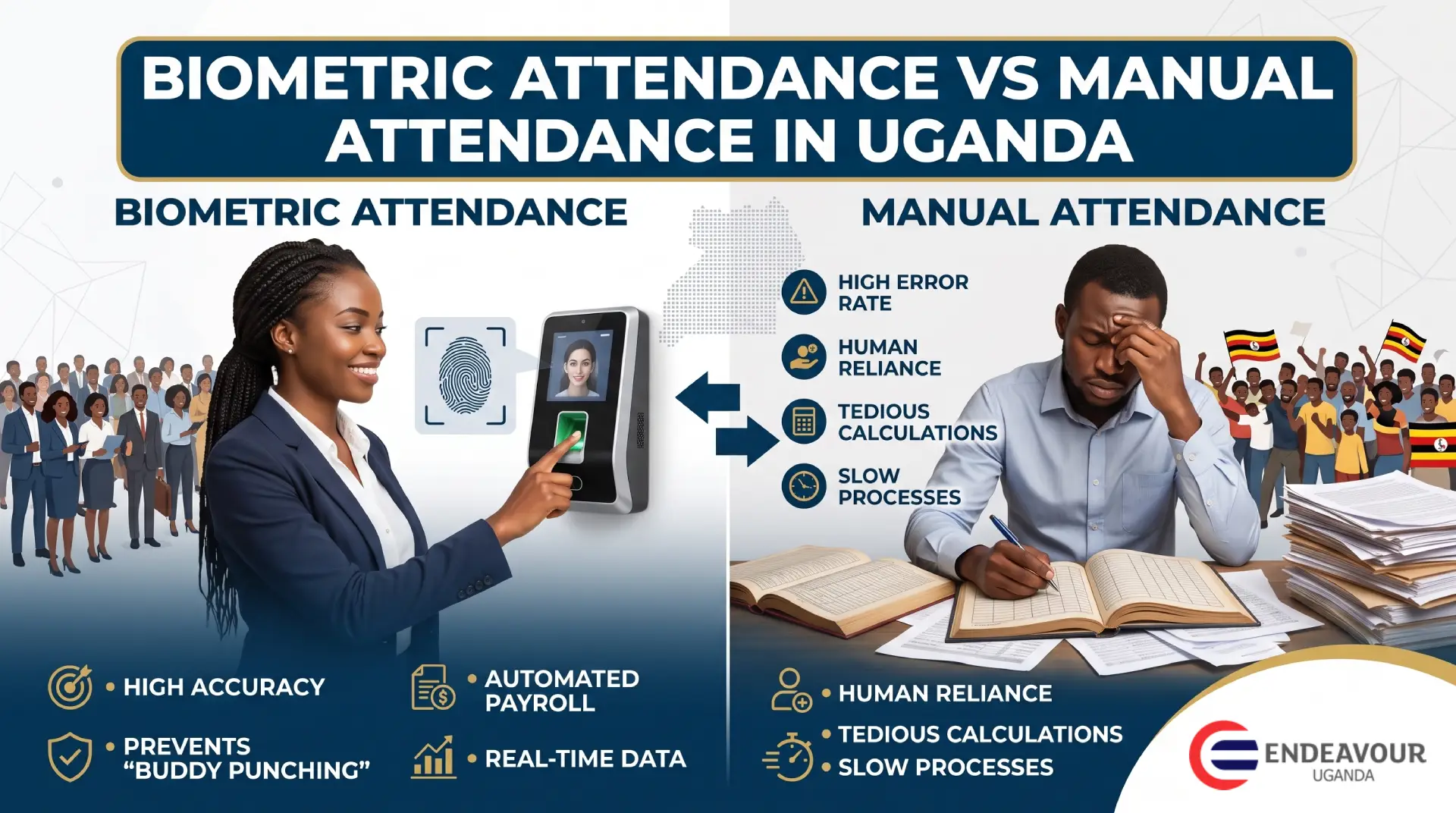
Employee attendance is one of the most important parts of workforce management.
Businesses need to know when employees arrive, when they leave, how many hours they work, whether they are absent, and whether they have worked overtime.
Traditionally, many businesses have relied on attendance registers, paper timesheets, Excel spreadsheets or manual attendance records.
However, as businesses grow, manually managing employee attendance can become increasingly difficult.
This is where a biometric attendance system Uganda businesses can use becomes relevant.
Biometric attendance can use technologies such as fingerprints or facial recognition to identify employees and record attendance. A manual system, by comparison, relies on employees or supervisors recording attendance themselves.
For businesses considering time attendance software Uganda, the question is not simply whether biometric technology is modern. The more important question is whether it can help solve real attendance, payroll and workforce management challenges.
Enquest HRMS by Endeavour Uganda provides an integrated approach to employee management, while Endeavour Uganda also provides dedicated attendance and biometric solutions for businesses looking to modernize workforce time tracking.
Let’s compare biometric attendance and manual attendance across the areas that matter most to Ugandan businesses.
What Is Manual Employee Attendance?
Manual attendance is a traditional method of recording employee working hours.
Depending on the organization, it may involve:
- Paper attendance registers
- Signature sheets
- Excel spreadsheets
- Manual timesheets
- Supervisor-maintained records
- Manual shift registers
- Attendance books
Employees may sign in when they arrive and sign out when they leave.
The HR team then uses these records to determine attendance, absences, working hours and sometimes overtime.
Why Businesses Still Use Manual Attendance
Manual attendance remains common because it can appear simple and inexpensive.
A small business may think:
“Why invest in an attendance system when employees can simply sign a register?”
For a very small workforce, this may initially seem manageable.
However, the challenges often become more visible as employee numbers increase.
What Is a Biometric Attendance System?
A biometric attendance system uses a person’s unique biological characteristics to verify their identity.
Common biometric attendance technologies include:
- Fingerprint recognition
- Facial recognition
- Face readers
- Other biometric identification methods
Instead of asking an employee to write their name or sign a sheet, the system verifies the employee and records the attendance event electronically.
This creates a digital attendance record that can be used for attendance monitoring, reporting and, depending on the system, payroll processing.
Biometric Attendance in Modern HR Management
Modern businesses are increasingly looking at attendance as part of a broader HR technology ecosystem.
Rather than keeping attendance in isolation, businesses can connect employee records, attendance, leave, overtime and payroll.
This approach is consistent with the broader movement toward integrated HR technology and reducing fragmented HR processes.
For organizations evaluating HR software Uganda, integrated attendance management can therefore be an important consideration.
Biometric Attendance vs Manual Attendance: Key Differences
| Feature | Manual Attendance | Biometric Attendance |
| Attendance recording | Paper or spreadsheet | Digital |
| Employee identification | Signature/name | Biometric verification |
| Data entry | Mostly manual | Automated |
| Attendance reports | Manual preparation | System-generated |
| Risk of duplicate entries | Higher | Lower |
| Time tracking | Manual | Digital |
| Overtime tracking | Often manual | Can be automated |
| Payroll integration | Usually manual | Can be integrated |
| Record searching | Time-consuming | Faster |
| Shift tracking | Manual | System-based |
| Attendance history | Physical files/spreadsheets | Digital records |
| Scalability | Becomes difficult as staff grow | Designed for larger workforces |
The exact capabilities depend on the technology and configuration used by each organization.
1. Accuracy of Employee Attendance
One of the main reasons businesses consider biometric attendance is the need for reliable employee identification.
With a paper register, an employee may write their name and arrival time manually.
With a biometric system, the employee’s identity is verified through the configured biometric method.
Manual Attendance Challenges
Manual records can create several issues:
- Incorrect handwriting
- Missing entries
- Incorrect times
- Forgotten signatures
- Duplicate entries
- Incomplete records
- Difficulty verifying who made an entry
These problems can make attendance reconciliation more time-consuming for HR teams.
How Biometric Attendance Helps
A biometric attendance system Uganda businesses use can electronically record attendance events after verifying the employee.
This can create a more consistent attendance record and reduce the amount of manual data entry required.
However, biometric technology is not automatically perfect. Businesses still need proper device installation, employee enrollment, system maintenance and appropriate policies.
2. Employee Time Tracking
Accurate time tracking is particularly important for organizations with:
- Shift workers
- Factory employees
- Retail staff
- Security teams
- Hospitality employees
- Field workers
- Warehouse employees
- Employees working different schedules
Manual attendance can make it difficult to analyze working hours across a large workforce.
A digital employee time tracking software solution can provide structured attendance data that HR teams can use for reporting.
Workforce Time Tracking With Digital Systems
Businesses looking for workforce time tracking solutions can benefit from systems that organize employee attendance information digitally.
Endeavour Uganda’s Time Master software is designed to support employee time and attendance management, including attendance processing, shift management and overtime-related tracking.
This can reduce the amount of time HR teams spend manually reviewing attendance sheets.
3. Payroll and Attendance Management
Attendance and payroll are closely connected.
Employee attendance can affect:
- Overtime
- Absences
- Working hours
- Leave
- Shift allowances
- Other payroll-related calculations
When attendance is recorded manually, HR teams may need to transfer information into payroll spreadsheets or payroll software.
That creates another opportunity for data-entry errors.
Connecting Attendance With Payroll
An integrated payroll and attendance approach can help businesses reduce unnecessary manual transfers between systems.
Enquest HRMS by Endeavour Uganda is designed to bring employee management and HR processes together, helping businesses manage important workforce information in a more centralized environment.
For businesses searching for HR software Uganda, connecting employee attendance with broader HR and payroll processes can be an important consideration.
4. Preventing Attendance Fraud
Manual attendance systems can be difficult to verify.
For example, if employees sign a paper register, management may have limited ability to determine whether the employee personally recorded the entry.
This is one reason organizations explore biometric identification.
Biometric Employee Verification
With biometric attendance, the employee is identified through the configured biometric credential.
This can make it more difficult for one employee to record attendance on behalf of another employee.
For organizations concerned about attendance accuracy, a biometric attendance system can therefore provide an additional layer of identity verification.
The technology does not eliminate every attendance-management issue, but it can reduce reliance on self-reported attendance records.
5. Attendance Reporting
HR managers and business owners often need attendance reports.
They may want to understand:
- Who was absent?
- Who arrived late?
- Who left early?
- How many hours did employees work?
- How much overtime was recorded?
- Which employees worked particular shifts?
- What attendance patterns are appearing?
With manual attendance, generating these reports may involve reviewing paper registers or spreadsheets.
Digital Attendance Reports
A digital attendance management system can organize attendance information in a structured format.
Instead of searching through multiple attendance books, HR teams can use system-generated attendance information.
This can be especially useful as employee numbers increase.
6. Managing Shifts and Overtime
Not every employee works the same schedule.
Businesses may have:
- Morning shifts
- Evening shifts
- Night shifts
- Rotating shifts
- Weekend shifts
- Overtime
- Different departmental schedules
Manual attendance can make shift and overtime calculations difficult.
Shift Management Software
Businesses with shift-based employees should consider whether their time attendance system supports shift schedules and overtime tracking.
A digital solution can make it easier to organize employee schedules and analyze attendance against those schedules.
For businesses in Uganda, Time Master can support time and attendance processes that include shift and overtime management.
7. Face Recognition Attendance
Fingerprint systems are not the only form of biometric attendance.
Face recognition is another increasingly visible technology in modern employee attendance management.
A face recognition system Uganda businesses use can identify employees using facial characteristics and record attendance electronically.
Face Reader Attendance
Face recognition attendance can be useful for organizations looking for contactless employee identification.
It can also provide a digital attendance trail that can be used by HR teams for workforce reporting.
Endeavour Uganda provides a Face Recognition System in Kampala, Uganda for organizations looking to implement modern employee identification and attendance technology.
Businesses should still consider factors such as device placement, lighting, employee enrollment, privacy requirements, system reliability and backup procedures before deployment.
8. Data Security and Employee Records
Attendance information is employee information.
Businesses therefore need to consider how attendance data is collected, stored, accessed and protected.
A paper attendance book can be physically accessed by employees or visitors depending on how it is stored.
Digital systems require their own security controls.
Choosing a Secure Attendance Solution
When evaluating an employee attendance system, businesses should ask:
- Who can access attendance information?
- How are employee records stored?
- Can administrators control access?
- Are reports protected?
- What happens if the device stops working?
- Is there a backup process?
- How is biometric information handled?
- What privacy policies apply?
Technology should be implemented alongside appropriate internal policies and responsible data management practices.
9. Attendance and HR Automation
Manual attendance requires HR teams to spend time collecting, checking and transferring information.
Digital attendance systems can automate parts of this process.
For example:
Employee → Attendance Device → Attendance Record → HR System → Reports → Payroll Process
Instead of:
Employee → Paper Register → HR Staff → Spreadsheet → Manual Calculation → Payroll
Automation can help reduce repetitive administrative work.
This is part of the wider movement toward HR automation and integrated HR systems. Current HR technology discussions increasingly emphasize connected systems rather than payroll, attendance and leave operating as isolated tools.
10. Scalability for Growing Businesses
Manual attendance can work differently at different business sizes.
A business with 10 employees may find a paper register manageable.
But consider an organization with:
- 50 employees
- 100 employees
- 300 employees
- Multiple branches
- Multiple shifts
- Multiple departments
The volume of attendance information increases significantly.
Scaling Employee Attendance Management
A digital attendance management system can help businesses organize attendance information as the workforce grows.
This is particularly relevant for businesses expanding across branches or locations.
Instead of maintaining separate paper attendance books at every location, businesses can explore centralized or connected attendance systems depending on their infrastructure and operational requirements.
Manual Attendance vs Biometric Attendance: Cost Considerations
At first glance, manual attendance may appear cheaper.
There may be no device purchase, installation cost or software subscription.
But the real cost of attendance management includes more than technology.
Businesses should also consider:
- HR employee time
- Payroll reconciliation
- Data-entry work
- Attendance disputes
- Reporting time
- Overtime calculation
- Record storage
- Administrative errors
- Productivity lost to repetitive work
The Total Cost of Manual Attendance
For a growing organization, the administrative cost of manual attendance can increase over time.
A business should therefore compare the total cost of ownership, rather than looking only at the initial price of an attendance device or software.
When Does Your Business Need Biometric Attendance?
There is no single attendance solution that is suitable for every business.
However, biometric attendance may be worth considering when your organization has:
Multiple Employees
As employee numbers increase, manual attendance becomes more difficult to manage.
Shift-Based Employees
Businesses operating multiple shifts can benefit from structured digital attendance records.
Overtime
If overtime calculations depend on working hours, digital attendance data may make the process easier to manage.
Multiple Locations
Organizations with multiple branches may need a more centralized approach to workforce attendance.
Attendance Disputes
If employees frequently disagree about recorded attendance, a digital attendance trail can provide more structured records.
Payroll Integration Requirements
Businesses that want attendance information to feed into payroll processes may benefit from an integrated solution.
How Enquest HRMS Supports Modern Employee Management
Attendance is only one part of HR management.
A complete workforce management strategy may also involve:
- Employee records
- Payroll
- Leave management
- Attendance
- Time tracking
- Overtime
- Performance management
- HR reporting
- Employee administration
This is where an HRMS Uganda solution can become useful.
Enquest HRMS by Endeavour Uganda is designed to help businesses manage employee and HR processes through a more centralized system.
Instead of managing employee records, attendance and payroll through disconnected spreadsheets, businesses can work toward a more integrated HR environment.
Biometric Attendance and Payroll Software
Attendance becomes even more valuable when it works alongside payroll.
For example, employee attendance data can provide information about:
- Working hours
- Absences
- Overtime
- Shift attendance
- Late arrivals
That information can then support payroll processing depending on the system configuration.
Businesses looking for dedicated payroll solutions can also explore Pay Master Payroll Software from Endeavour Uganda.
The goal is to reduce unnecessary manual movement of information between attendance and payroll processes.
Biometric Attendance for Ugandan Businesses
For businesses operating in Uganda, attendance management needs to fit the organization’s actual workforce.
A solution that works for an office with 20 employees may not be appropriate for a factory with multiple shifts.
Similarly, a retail chain with several branches may have different requirements from a professional services company.
Consider Your Workforce Before Choosing
Before investing in a biometric attendance system Uganda, consider:
Workforce Size
How many employees will use the system?
Working Patterns
Do employees work fixed hours, shifts or overtime?
Locations
Is the business operating from one location or multiple branches?
Payroll
Does attendance affect payroll?
HR Software
Do you already use an HRMS or payroll system?
Connectivity
Does the solution need to work with your existing network and infrastructure?
Support
Will your business have access to installation, training and technical support?
These questions can help you choose technology based on actual business requirements rather than simply choosing the newest device.
Why Integrated HR Technology Matters
The bigger opportunity is not simply replacing a paper register with a biometric device.
The real opportunity is connecting attendance with other HR processes.
A modern workforce management environment can connect:
Employee Records → Attendance → Leave → Overtime → Payroll → Reports
This creates a more connected flow of employee information.
Current African HR technology trends point toward greater system consolidation because fragmented systems can create data gaps, duplicated work and inconsistent reporting.
For businesses considering HR solutions Uganda, this integrated approach can be more valuable than treating attendance as an isolated activity.
Final Verdict: Biometric or Manual Attendance?
The right choice depends on the organization’s size, workforce structure, budget and operational requirements.
Manual attendance may remain practical for some very small organizations with simple working arrangements.
However, businesses with larger workforces, multiple shifts, overtime, multiple locations or payroll-related attendance requirements may find a digital biometric attendance system more suitable for structured workforce management.
The important point is to look beyond the attendance device itself.
A successful attendance strategy should consider:
- Employee identification
- Time tracking
- Attendance reporting
- Shift management
- Overtime
- Leave
- Payroll
- HR reporting
- Data security
- System support
For businesses in Uganda, Endeavour Uganda provides solutions across these areas, including Enquest HRMS, Time Master, Pay Master and biometric/face recognition solutions.
If your business is still relying on paper registers or Excel for attendance, now may be a good time to evaluate whether a modern employee attendance system can simplify your HR processes.
Explore Enquest HRMS by Endeavour Uganda and discover how integrated HR technology can support employee management, attendance and payroll processes.
Frequently Asked Questions
1. What is the difference between biometric attendance and manual attendance?
Manual attendance relies on paper registers, spreadsheets or timesheets, while biometric attendance uses technologies such as fingerprints or facial recognition to verify employees and record attendance digitally.
2. Is biometric attendance suitable for businesses in Uganda?
Biometric attendance can be suitable for Ugandan businesses that need structured employee attendance tracking, particularly organizations with larger workforces, shifts, overtime or multiple locations. The right solution depends on each organization’s requirements.
3. What is a biometric attendance system Uganda?
A biometric attendance system Uganda is a workforce attendance solution that uses biometric identification, such as fingerprint or facial recognition, to verify employees and record attendance.
4. Can biometric attendance be connected to payroll?
Depending on the software and configuration, biometric attendance data can be connected to payroll processes. This can help businesses use attendance, working hours and overtime information during payroll processing.
5. What is employee time tracking software?
Employee time tracking software helps organizations record employee working hours, attendance, shifts, overtime and other time-related information digitally.
6. Is face recognition better than fingerprint attendance?
Neither technology is automatically better for every organization. Businesses should consider their workforce, environment, device requirements, privacy considerations, reliability and operational needs before selecting face recognition or fingerprint attendance.
7. Can biometric attendance reduce attendance fraud?
Biometric attendance can make it more difficult for one employee to record attendance on behalf of another because the system verifies the employee using a biometric credential. However, proper implementation and monitoring are still important.
8. What is the best attendance system for a growing business?
The appropriate attendance management system depends on workforce size, shifts, locations, payroll requirements, reporting needs and budget. Growing businesses may consider digital attendance systems that can scale and integrate with HR and payroll processes.
9. Can Enquest HRMS manage employee attendance?
Enquest HRMS by Endeavour Uganda is designed as an HR management solution that supports centralized employee and HR processes. Businesses can also use Endeavour Uganda’s dedicated time and attendance solutions for workforce attendance management.
10. Where can I get biometric attendance and HR software in Uganda?
Businesses can explore biometric attendance, HR software Uganda, payroll and employee management solutions from Endeavour Uganda, including Enquest HRMS and related workforce management products.