




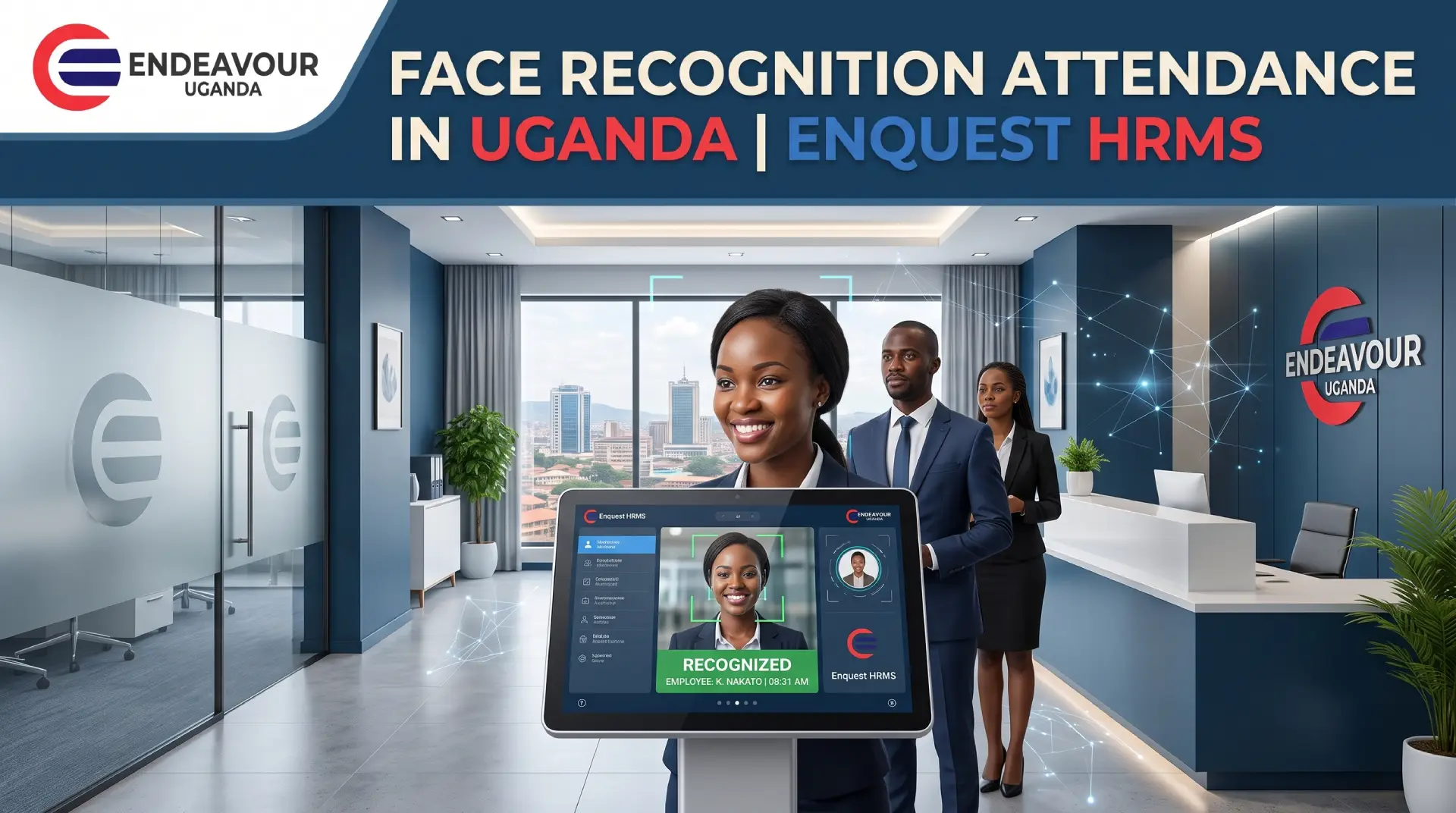
Employee attendance has traditionally been managed through attendance registers, spreadsheets, fingerprint machines, ID cards and other manual processes.
But as businesses grow, tracking when employees arrive, leave, work overtime or move between shifts can become increasingly difficult.
This is one reason modern businesses are exploring face recognition attendance in Uganda as part of their wider HR technology strategy.
A face recognition attendance system uses a camera and facial recognition technology to verify an employee’s identity and record an attendance event. When connected to an HR platform, those attendance records can become part of a broader workforce management process involving shifts, overtime, leave and payroll.
For businesses looking for a more connected approach, Enquest HRMS by Endeavour Uganda combines employee management, payroll, time and attendance, biometric integration, face recognition attendance, leave management, shift management and overtime management in one platform.
What Is Face Recognition Attendance?
A face recognition attendance system uses facial features to identify an enrolled employee when they check in or check out.
A typical process involves:
- Employee facial enrollment
- Camera-based face detection
- Identity verification
- Attendance timestamp recording
- Synchronization with attendance software
- Reporting for HR and management
- Using attendance information for related processes such as overtime and payroll
Unlike a traditional paper register, the system can automatically create digital attendance records.
This makes face recognition attendance particularly relevant for organizations that want to reduce manual attendance administration.
For businesses exploring dedicated attendance technology, Endeavour Uganda also provides Time Attendance Software in Uganda as part of its workforce management solutions.
Why Are Ugandan Businesses Moving Toward Digital Attendance?
Attendance management becomes more complicated as organizations add employees, departments, shifts and locations.
A growing company may need to track:
- Employee check-in and check-out
- Late arrivals
- Early departures
- Absences
- Breaks
- Shift schedules
- Overtime
- Leave
- Attendance corrections
- Employee working hours
- Payroll-related attendance information
Managing all of this manually can create additional administrative work.
Across Africa, HR technology is increasingly moving toward integrated systems rather than disconnected tools for payroll, leave, attendance and other HR processes.
This is where an integrated HR software Uganda solution can become useful.
Instead of treating attendance as an isolated activity, businesses can connect attendance information with other employee-management processes.
How Face Recognition Attendance Works
1. Employee Enrollment
The first step is registering employees in the attendance system.
The organization creates an employee profile and associates the employee with their facial recognition credentials.
The enrollment process should be handled carefully because facial information is sensitive personal data.
2. Face Detection
When an employee approaches the attendance device, its camera detects a face.
The system then processes the available facial information according to its recognition method.
3. Identity Verification
The system compares the captured information with the enrolled employee record.
If the employee is successfully verified, the attendance event can be recorded.
4. Attendance Recording
The system records information such as:
- Employee identity
- Date
- Check-in time
- Check-out time
- Attendance status
- Assigned shift
- Relevant attendance events
This creates a digital employee attendance record.
5. HR Attendance Processing
The attendance information can then be used by an attendance management system for reporting, shift monitoring and workforce administration.
With an integrated HRMS, attendance can also become part of payroll and overtime workflows.
Face Recognition vs Traditional Attendance
Different organizations use different attendance methods. The appropriate approach depends on workforce size, workplace conditions, operational requirements and internal policies.
| Feature | Manual Register | ID/Card System | Fingerprint | Face Recognition |
| Digital attendance | Limited | Yes | Yes | Yes |
| Automated timestamp | Usually no | Yes | Yes | Yes |
| Physical contact required | Yes | Usually | Yes | No |
| Identity verification | Manual | Card-based | Biometric | Facial biometric |
| Attendance reporting | Manual | Automated | Automated | Automated |
| Payroll integration | Usually manual | Possible | Possible | Possible |
| Suitable for shift management | Limited | Yes | Yes | Yes |
The key difference with face recognition is that employees can be verified using facial biometric technology rather than a physical card or fingerprint.
7 Benefits of Face Recognition Attendance for Businesses
1. Faster Employee Verification
Face recognition can allow employees to verify themselves without manually writing their names or presenting a physical attendance card.
This can simplify attendance recording, particularly in workplaces with many employees arriving around the same time.
2. Digital Attendance Records
Instead of relying on paper registers, businesses can maintain digital attendance information.
This can make it easier for HR teams to search, review and report attendance records.
3. Better Employee Time Tracking
A modern employee time tracking software solution can provide visibility into working hours, attendance patterns, shifts and overtime.
This can be particularly useful for organizations with different schedules or multiple employee groups.
4. Reduced Manual Attendance Administration
HR teams can spend considerable time collecting attendance records, checking registers and preparing information for payroll.
Automated attendance systems can reduce some of this repetitive work.
5. Support for Shift Management
Businesses operating multiple shifts need more than simple clock-in and clock-out records.
An integrated system can associate employees with different schedules and help HR teams review attendance against assigned shifts.
6. Better Overtime Tracking
Overtime can become difficult to manage when attendance information is stored separately from HR or payroll records.
A connected payroll and attendance process can make it easier to identify hours that may require overtime review according to company policies and applicable employment requirements.
7. Centralized HR Information
The broader value of digital attendance comes when it works together with employee management, leave, payroll and other HR functions.
That is one reason modern businesses are increasingly looking at integrated HR platforms rather than isolated attendance tools.
Face Recognition Attendance and Payroll
Attendance information can have a direct relationship with payroll administration.
For example, an organization may need attendance information when reviewing:
- Working days
- Absences
- Late arrivals
- Early departures
- Overtime
- Shift schedules
- Approved leave
- Attendance adjustments
If these records are maintained manually, HR and payroll teams may need to repeatedly transfer information between systems.
With integrated payroll software Uganda, attendance information can become part of a more connected payroll workflow.
Enquest HRMS by Endeavour Uganda is designed to bring employee management, payroll and attendance functions together. Its published features include automated payroll, time and attendance, biometric integration, face recognition attendance, leave, shifts and overtime.
Businesses that want to explore payroll automation can also review Pay Master Payroll Software in Kampala, Uganda.
Face Recognition Attendance and Overtime
Overtime is one area where attendance information can become particularly important.
Consider an employee whose scheduled shift ends at 5:00 PM but who works additional approved hours.
A modern overtime tracking system can help the business record and review the additional time rather than relying on handwritten notes or separate spreadsheets.
The process can involve:
Attendance → Shift → Overtime → Approval → Payroll
The exact workflow should reflect the employer’s policies and applicable employment requirements.
This connected approach can reduce repetitive data entry and give HR teams a clearer record of how attendance information moves into payroll.
Face Recognition Attendance for Multiple Branches
Businesses operating across Kampala or other parts of Uganda may have employees working at different branches, offices, warehouses, stores or operational sites.
Managing attendance across multiple locations can create additional challenges.
A centralized employee attendance system can help organizations bring attendance information together instead of requiring HR teams to collect separate spreadsheets or physical registers from every location.
This is particularly useful when management needs consolidated information about:
- Employees present at each location
- Absenteeism
- Late arrivals
- Shift coverage
- Overtime
- Department attendance
- Branch-level workforce activity
The ability to centralize information is also consistent with the broader 2026 HR technology trend toward reducing fragmented HR systems.
Face Recognition Attendance and Employee Privacy in Uganda
Face recognition should not be treated only as an attendance technology issue.
It also involves personal data protection.
Uganda’s Personal Data Protection Office identifies biometric data as special personal data, meaning organizations need to pay particular attention to how such information is collected, processed, stored and protected.
The PDPO also highlights obligations around data protection governance, security, processing purposes and relationships with data processors.
Recent 2026 research specifically examining biometric attendance systems in Ugandan private universities emphasizes privacy protection, technical security, governance and clear procedures when biometric attendance is implemented.
What Should Businesses Consider?
Before implementing a biometric attendance system Uganda, organizations should consider:
- Why biometric attendance is being collected
- What information is being stored
- Who can access the information
- How the information is secured
- How long information is retained
- What happens when an employee leaves
- Which third parties process the data
- What policies govern the system
- How employees are informed about its use
Businesses should obtain appropriate professional advice on their specific obligations under Uganda’s data-protection framework.
Face Recognition vs Fingerprint Attendance
Both facial recognition and fingerprint technology are biometric attendance methods.
The choice depends on the organization’s requirements.
Face Recognition
Face recognition can provide:
- Contactless verification
- Camera-based attendance
- Fast employee identification
- Integration with digital attendance systems
Fingerprint Attendance
Fingerprint systems can provide:
- Biometric employee verification
- Digital attendance records
- Automated time tracking
- Integration with HR and payroll systems
The important consideration is not simply the biometric method itself.
Businesses should evaluate the complete attendance management system, including reliability, reporting, integrations, security, employee workflows and support.
How Enquest HRMS Supports Face Recognition Attendance
For businesses searching for HR software Uganda, Enquest HRMS by Endeavour Uganda provides an integrated approach to employee management.
The platform includes modules for:
- Employee management
- Payroll management
- Time and attendance
- Biometric attendance
- Face recognition attendance
- Leave management
- Shift management
- Overtime management
- Employee self-service
- HR reports and analytics
These modules allow businesses to manage several HR processes from a centralized platform.
You can learn more about Enquest HRMS by Endeavour Uganda and its employee management capabilities.
From Face Recognition to Complete Workforce Management
A face recognition device by itself solves only one part of the attendance problem.
The bigger opportunity is connecting attendance with the rest of the employee lifecycle.
For example:
Employee Record
↓
Face Recognition Attendance
↓
Time & Attendance
↓
Shift Management
↓
Overtime Tracking
↓
Leave Management
↓
Payroll Processing
↓
HR Reports
This is the type of connected workflow that modern HRMS Uganda platforms can support.
For organizations that need a broader HR solution, HR Software Uganda from Endeavour Uganda provides a starting point for exploring integrated employee-management capabilities.
8 Features to Look for in a Face Recognition Attendance System
If your organization is evaluating a face recognition system Uganda, consider these features.
1. Reliable Face Recognition
The system should provide consistent employee identification under the conditions in which it will actually be used.
2. Attendance Synchronization
Attendance records should move efficiently into the central attendance platform.
3. Shift Management
The system should support different employee schedules where required.
4. Overtime Management
It should help organizations record and review overtime according to internal policies.
5. Payroll Integration
Attendance information should be capable of supporting payroll workflows without unnecessary re-entry.
6. Reporting
HR teams should be able to generate attendance reports and review employee time information.
7. Access Controls
Organizations should be able to control who can view or modify attendance and employee information.
8. Data Protection Controls
Because facial information is biometric data, businesses should consider security, retention, access and governance when selecting a system.
Signs Your Business May Need Better Attendance Tracking
Your organization may need to review its attendance process if:
- Employees still sign paper attendance registers.
- HR manually enters attendance into Excel.
- Payroll requires repeated attendance reconciliation.
- Overtime records are maintained separately.
- Managers cannot easily see who is present.
- Different branches use different attendance processes.
- Employees frequently dispute attendance records.
- HR spends significant time correcting attendance data.
- Leave and attendance records are disconnected.
- Management lacks consolidated workforce reports.
If several of these situations sound familiar, moving toward a structured time attendance software Uganda solution may help reduce manual administration.
Endeavour Uganda’s Time Master Software is another relevant solution for organizations looking to improve employee time and attendance management.
When Should a Business Consider Face Recognition Attendance?
Face recognition attendance may be worth evaluating when a business has:
- A growing workforce
- Multiple shifts
- Multiple locations
- Frequent attendance disputes
- Manual attendance registers
- High overtime administration
- Payroll reconciliation challenges
- A need for centralized workforce reporting
- Existing biometric infrastructure
- A broader HR automation strategy
However, technology should be selected based on actual business requirements rather than simply adopting a biometric device because it is available.
Face Recognition Attendance as Part of HR Automation in Uganda
The future of HR technology is increasingly about connected workflows rather than isolated tools.
A business may start by digitizing attendance, then connect it with payroll, leave, employee records, shifts and reporting.
This can create a more complete HR automation Uganda strategy.
For example:
Manual Register
→ Digital Attendance
→ Biometric Verification
→ Face Recognition
→ Automated Time Tracking
→ Payroll Integration
→ HR Analytics
The goal is not simply to replace a paper register.
The goal is to create more reliable employee information that HR teams can use across daily workforce-management processes.
Recent African HR technology analysis similarly identifies system consolidation and integrated HR operations as important developments in 2026.
Why Enquest HRMS by Endeavour Uganda Matters
For Ugandan businesses, implementing face recognition attendance can be more useful when it is connected to the wider HR environment.
Enquest HRMS by Endeavour Uganda brings together employee records, payroll, time and attendance, biometric integration, face recognition, leave, shifts, overtime and HR reporting.
That means businesses can move beyond simply asking:
“Who came to work today?”
They can build a more complete picture of:
- Who is present
- Who is absent
- Who arrived late
- Who left early
- Which shift an employee belongs to
- How much overtime was recorded
- Which leave has been approved
- How attendance affects payroll
- What workforce reports management needs
Businesses that need assistance with payroll administration can also explore Payroll Outsource Services in Kampala, Uganda as another approach to managing payroll operations.
Final Thoughts
Face recognition attendance in Uganda is part of a wider shift toward digital workforce management.
For businesses still relying on paper registers, spreadsheets or disconnected attendance tools, modern biometric attendance can provide a more structured way to capture employee working time.
But the technology should be considered as part of a complete HR process.
A useful employee time tracking software solution should connect attendance with shifts, overtime, leave, payroll and reporting while giving appropriate attention to data security and privacy.
For businesses looking for an integrated approach, Enquest HRMS by Endeavour Uganda combines HR, payroll, attendance, biometric and employee-management capabilities in one platform.
The result is a move from simply recording attendance toward building a more connected HRMS Uganda environment for modern workforce management.
Frequently Asked Questions
1. What is face recognition attendance in Uganda?
Face recognition attendance is a biometric attendance method that uses facial recognition technology to verify employees and record their attendance time digitally.
2. Is face recognition attendance a biometric system?
Yes. Face recognition is a biometric identification method. Uganda’s Personal Data Protection Office lists biometric data among special personal data categories.
3. How does a face recognition attendance system work?
An employee is enrolled in the system, the attendance device detects their face, verifies the employee and records the attendance event with a timestamp.
4. Can face recognition attendance connect with payroll?
Yes. Where the attendance platform and payroll system are integrated, attendance information can support payroll processing, overtime review and other calculations.
5. Can face recognition attendance track overtime?
An integrated attendance and HR system can record working-time information that supports overtime tracking and review according to company policies.
6. Is face recognition better than fingerprint attendance?
Both are biometric attendance methods. The appropriate option depends on the organization’s workforce, environment, operational requirements, privacy considerations, system integrations and budget.
7. Can face recognition attendance be used for multiple branches?
Yes. A centralized attendance platform can allow organizations to manage employee attendance information across multiple locations, subject to the system’s architecture and connectivity.
8. Does Enquest HRMS support face recognition attendance?
Yes. Enquest HRMS by Endeavour Uganda lists face recognition attendance, biometric integration, time and attendance, payroll, leave, shift and overtime management among its capabilities.
9. Is biometric employee data protected in Uganda?
Biometric data receives special treatment under Uganda’s data-protection framework. Organizations should consider their obligations regarding lawful processing, security, access, retention and data governance.
10. Where can businesses in Uganda get HR and attendance software?
Businesses can explore Enquest HRMS by Endeavour Uganda for integrated employee management, payroll, attendance, biometric, face recognition, leave, shift and overtime management.