




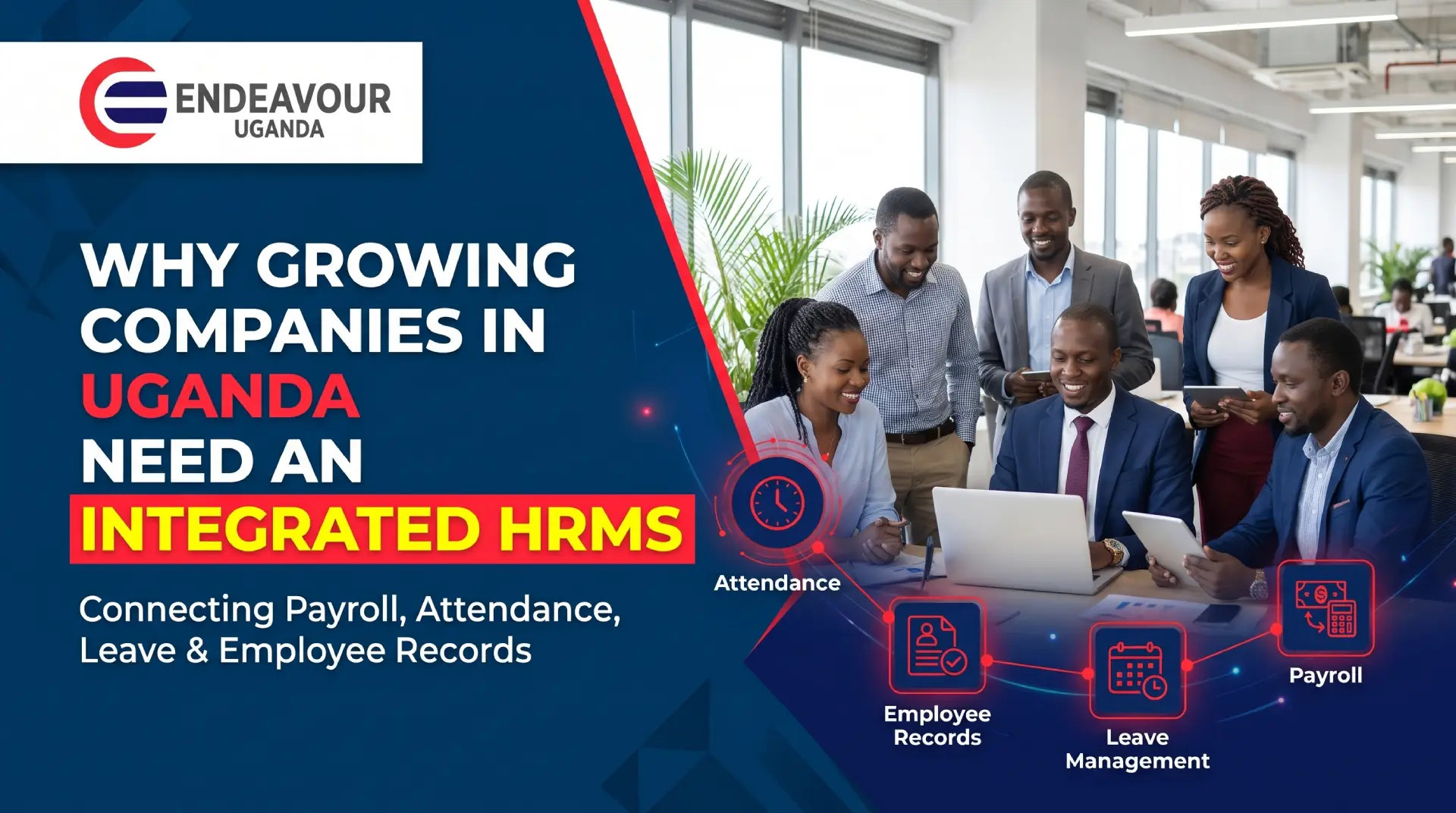
As a company grows, managing employees becomes more complicated. A business that once managed staff information through spreadsheets and paper records may eventually have multiple departments, branches, employee categories, shifts, and increasingly demanding payroll requirements.
At this stage, using separate tools for employee records, attendance, leave, and payroll can create unnecessary administrative work. HR teams may have to enter the same information several times, reconcile different records, and manually check whether payroll calculations match attendance and approved leave.
An integrated HRMS in Uganda helps solve this challenge by bringing essential human resource functions together in one connected system. It gives management a more organised way to manage employees, improve HR processes, and support business growth.
What Is an Integrated HRMS?
An Integrated Human Resource Management System (HRMS) is software that connects different HR activities through a central platform.
Instead of using one application for attendance, another for payroll, and spreadsheets for employee information, an integrated HRMS allows these functions to work together.
Depending on the system, it may include:
- Employee information and records management.
- Payroll and salary processing.
- Time and attendance tracking.
- Leave and absence management.
- Shift and overtime management.
- Recruitment and onboarding.
- Performance management.
- Employee self-service.
- HR reports and workforce analytics.
The main advantage is that information can flow between related HR processes without requiring repeated manual entry.
Why Separate HR Systems Become Difficult as Companies Grow
Separate tools may work when a business has a small workforce. However, as the organisation expands, disconnected information can become a major administrative challenge.
1. Duplicate Employee Information
When HR and payroll use separate databases, employee details may need to be updated in multiple places.
For example, if an employee receives a promotion or salary adjustment, the change may need to be recorded in the HR system, payroll software, and other internal records.
If one record is not updated, the organisation may end up working with inconsistent information.
An integrated HRMS provides a central employee record that authorised departments can use for their respective processes.
2. Payroll Errors and Delays
Payroll depends on accurate employee information, attendance, approved leave, overtime, allowances, and deductions.
When these details are maintained separately, payroll teams may spend considerable time collecting and checking information before processing salaries.
An integrated system can connect relevant attendance and leave information with payroll, helping reduce manual reconciliation and avoid preventable errors.
For businesses looking for dedicated payroll capabilities, Pay Master Payroll Software is another solution to explore.
3. Limited Visibility Across Departments
Growing companies often have different departments, managers, and reporting structures.
Without a connected HR platform, management may struggle to obtain accurate information about:
- Total employee headcount.
- Department-wise staffing.
- Attendance and absenteeism.
- Monthly payroll costs.
- Leave balances.
- Employee movements and changes.
An integrated HRMS helps bring this information together through reports and dashboards, giving authorised managers better visibility into workforce operations.
4. More Administrative Work
As employee numbers increase, HR teams spend more time handling routine activities such as updating records, checking attendance, processing leave requests, and preparing payroll information.
Automation can reduce repetitive tasks and allow HR professionals to focus more on employee engagement, workforce planning, recruitment, and organisational development.
7 Important Benefits of an Integrated HRMS for Growing Companies
1. Centralised Employee Data
A central employee database makes it easier to maintain accurate and organised workforce information.
HR teams can access employee profiles, job details, joining dates, salary information, employment documents, and other relevant records according to their access permissions.
This reduces dependence on scattered files and helps maintain consistency across HR processes.
2. Connected Attendance and Payroll
Attendance information can directly affect salary calculations, overtime, and other payroll components.
When attendance and payroll are connected, approved working hours, absences, and overtime records can be made available to the payroll process.
This reduces the need to manually transfer information between systems.
For companies with multiple shifts or locations, integrated attendance management can also improve workforce coordination.
3. Better Leave Management
Managing leave becomes more complicated when several departments have different staffing requirements.
An integrated HRMS can allow employees to submit leave requests, managers to approve them, and HR teams to monitor leave balances.
Where the system supports it, approved leave information can also be reflected in attendance records and related payroll processes.
4. Improved HR Control Across Branches
Companies operating from multiple locations need consistent employee information and HR procedures.
A centralised HRMS can help authorised managers monitor staff information across branches, subject to role-based access permissions.
This is particularly useful for retail chains, manufacturing companies, hotels, healthcare organisations, and service businesses with distributed teams.
5. Faster HR Reporting and Decision-Making
Business leaders need reliable information to make workforce decisions.
An integrated HRMS can provide reports on headcount, payroll costs, attendance, leave, and other workforce activities.
For example, management can review staffing levels across departments, identify recurring attendance issues, and understand how workforce costs change as the business expands.
6. Improved Employee Experience
Employees should not need to contact HR for every routine request.
Employee self-service features can allow staff to access payslips, request leave, review selected personal information, and check relevant HR details.
This reduces routine enquiries and gives employees a more convenient way to interact with HR.
7. A Scalable Foundation for Business Growth
A company should not have to replace its HR system every time it adds employees or opens a new branch.
A suitable integrated HRMS should support increasing employee numbers, additional departments, new approval workflows, and more advanced HR functions as the organisation develops.
Choosing a scalable system early can help avoid unnecessary software changes later.
Which Companies in Uganda Should Consider an Integrated HRMS?
An integrated HRMS can be useful for different types of growing organisations.
| Business type | How an integrated HRMS helps |
| Manufacturing companies | Manages shifts, attendance, overtime, and payroll information |
| Retail chains | Coordinates employee records and attendance across branches |
| Hotels and hospitality | Supports shift planning, leave, attendance, and payroll |
| Healthcare organisations | Helps manage employee records, shifts, and workforce availability |
| Construction companies | Organises employee information across projects and locations |
| IT and service companies | Supports employee records, leave, attendance, and performance processes |
The need for integration depends more on operational complexity than on employee numbers alone. A company with several locations or shift patterns may need connected HR processes earlier than a business with the same headcount operating from one office.
How to Choose the Right HRMS for Your Company in Uganda
Selecting an HRMS is an important business decision. The software should address current operational problems while supporting future requirements.
Before choosing a solution, consider the following factors.
1. Local Payroll Requirements
Confirm that the system supports relevant Ugandan payroll requirements, including applicable PAYE and NSSF calculations. Ask how statutory updates are handled and whether payroll reports can be reviewed before processing.
2. Integration Between HR Modules
Do not evaluate each module in isolation. Check whether employee records, attendance, leave, overtime, and payroll actually share information.
A platform described as integrated should demonstrate how information moves between its modules.
3. Ease of Use
HR software should be practical for HR teams, managers, and employees.
Request a demonstration of common tasks such as adding an employee, approving leave, recording attendance, and preparing payroll.
4. Security and Access Control
Employee records and salary information are confidential. Check whether the system provides user permissions, secure access, data backups, and appropriate controls over sensitive information.
5. Scalability and Support
Consider whether the provider can support your organisation as it expands. Ask about implementation, employee onboarding, training, technical support, system updates, and integration requirements.
Why Consider Enquest HCM Suite?
For companies looking to connect their HR operations, Enquest HCM Suite is an HRMS solution offered by Endeavour Uganda.
An integrated HR platform can help organisations bring employee management, payroll, attendance, leave, and other HR activities into a more structured environment.
The right configuration depends on the company’s size and requirements. Businesses should evaluate the relevant modules through a product demonstration and confirm how each process works before implementation.
You can also explore HR software solutions in Uganda to understand the available options.
Integrated HRMS vs Separate HR and Payroll Software
| Area | Separate systems | Integrated HRMS |
| Employee records | May be stored in different databases | Centralised employee information |
| Attendance | May require manual data transfer | Can connect with other HR processes |
| Payroll | Often requires manual reconciliation | Can use connected HR and attendance data |
| Leave | May be managed separately | Can connect leave records with attendance |
| Reporting | Information may need to be combined | More consolidated workforce reporting |
| Administration | More repetitive coordination | Greater opportunity for automation |
The benefits depend on the software’s actual integration capabilities. Before purchasing, ask the provider to demonstrate the workflows rather than relying only on a list of features.
Final Thoughts
As companies grow, HR management becomes more than maintaining employee records and preparing monthly salaries. It involves coordinating departments, tracking attendance, managing leave, controlling payroll information, and making informed workforce decisions.
Using separate tools for each activity can increase administrative work and make it harder to maintain consistent information.
An integrated HRMS in Uganda gives growing companies an opportunity to connect these processes, improve visibility, reduce repetitive work, and build a stronger foundation for expansion.
The important thing is to choose a solution that fits your current operations, supports local payroll requirements, and can grow with your organisation.
To explore HRMS options for your business, visit Endeavour Uganda or contact the team to discuss your HR management requirements.
Frequently Asked Questions
- What is an integrated HRMS?
An integrated HRMS is software that connects multiple HR functions, such as employee records, payroll, attendance, leave management, and reporting, within one platform.
- Why do growing companies need an integrated HRMS?
Growing companies need better coordination between HR processes. An integrated HRMS helps reduce duplicate data entry, improve payroll preparation, organise employee information, and provide better workforce visibility.
- What is the difference between HRMS and payroll software?
Payroll software primarily handles salary calculations, deductions, and payslips. An HRMS manages broader employee processes, including records, attendance, leave, recruitment, and performance. An integrated HRMS may also include payroll.
- Is an integrated HRMS suitable for SMEs in Uganda?
Yes. SMEs can benefit from connected HR processes as their employee numbers and administrative responsibilities increase. They can start with essential modules and add more functionality as needed.
- Can an HRMS manage multiple company branches?
Many HRMS platforms support multiple branches, departments, and locations. Businesses should confirm that the system supports centralised reporting, branch-level access, and appropriate permissions.
- Does an integrated HRMS help with payroll compliance in Uganda?
It can help organise payroll information and support applicable PAYE and NSSF calculations. Employers should confirm that the software reflects current statutory requirements and review payroll before finalisation.